


Cloud gaming has been “the future of the industry” for about a decade now. OnLive promised it in 2010. Google Stadia promised it in 2019 and then shut down in 2023 after losing roughly $1.5B. The current crop — Xbox Cloud Gaming, GeForce Now, PlayStation Plus Premium streaming, Amazon Luna — works meaningfully better than any of those, and yet the “Netflix for games” pitch still hasn’t landed the way subscription music or video did. The interesting question in 2026 isn’t whether cloud gaming exists. It does. The question is whether it’s actually becoming the primary way most people play.
The honest answer is no; and not even close, on a 5-year horizon. But that doesn’t mean cloud gaming is failing. It means the role it actually plays in the industry is different from the role its loudest promoters predicted. Knowing which is which matters if you’re deciding whether to subscribe, switch from a console, or write off the category entirely.

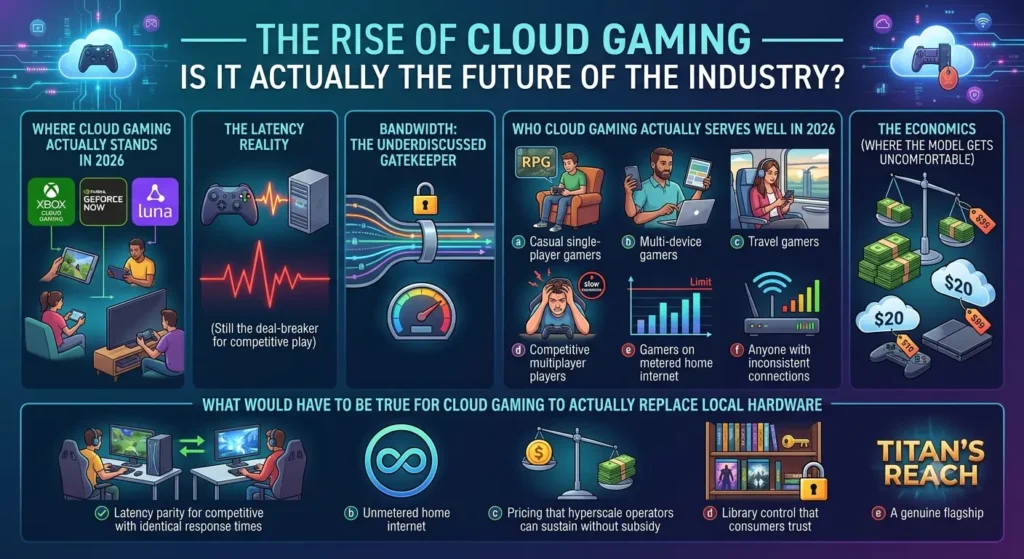
Where cloud gaming actually stands in 2026
Three services genuinely work in 2026, with three different value propositions:
- Xbox Cloud Gaming (included with Game Pass Ultimate at ~$20/month): the broadest library tied to a subscription, runs on any device with a browser, 1080p/60fps cap on most titles.
- GeForce Now ($10-$20/month tiered): streams games you already own on Steam, Epic, GOG. Up to 4K/120fps on the Ultimate tier. Best technical performance in the category.
- PlayStation Plus Premium ($18/month): cloud-streams PS5 games to PS5 hardware, PC, and select mobile. The smallest cloud-only library but the largest catalogue of cloud-eligible AAA PS exclusives.
Amazon Luna also exists, with smaller libraries and Prime-bundled pricing. It’s fine. It’s not category-shaping.
What’s gone: Google Stadia (2023), Shadow PC reborn under new owners (still niche), Tencent’s various cloud experiments outside China. The “every tech giant launches a cloud gaming service” wave from 2019-2021 cleared out, leaving the three credible operators above plus China-only services that don’t ship abroad.
The latency reality (still the deal-breaker for competitive play)
The single hardest problem in cloud gaming hasn’t been solved in 2026, and the marketing pretends otherwise. Round-trip latency from your input to the game responding to it, on the best modern cloud gaming setup (wired ethernet, premium ISP, geographically close server), runs 30-60ms above local play. On wifi or cellular, it’s 60-120ms above local. On worse connections, much higher.
For most single-player AAA, that’s invisible. For racing sims and rhythm games, it’s noticeable. For competitive multiplayer (Fortnite, Valorant, Counter-Strike, Apex), it’s a genuine handicap that ranked players will feel. The category that needs cloud gaming the least — casual single-player gamers — is the only category where current latency is comfortably acceptable.
5G has helped. 6G might close the gap further around 2028-2030. Edge computing (servers physically closer to users) is the most credible technical path to genuine local-equivalent latency, and it’s mostly already deployed in major US/EU metros. The remaining gap is mostly encoding delay (the server has to render and compress the frame before sending it), which is harder to reduce.
Bandwidth: the underdiscussed gatekeeper
Cloud gaming is bandwidth-heavy. Real numbers:
- 1080p/60fps: roughly 15-25 Mbps sustained, 50-150GB per hour
- 1440p/60fps: roughly 25-35 Mbps sustained
- 4K/60fps: roughly 35-50 Mbps sustained, 250-500GB per hour
For a household with metered or capped internet (still the majority of US homes through ISP data caps), heavy cloud gaming use is a real cost. A daily 2-hour 1080p session burns roughly 100GB/day — well above what most “1TB monthly cap” plans tolerate without overage fees.
This is the part of the value proposition cloud gaming services don’t put on their landing pages. The $20/month Xbox subscription assumes you have unmetered home internet. Many households still don’t.
Who cloud gaming actually serves well in 2026
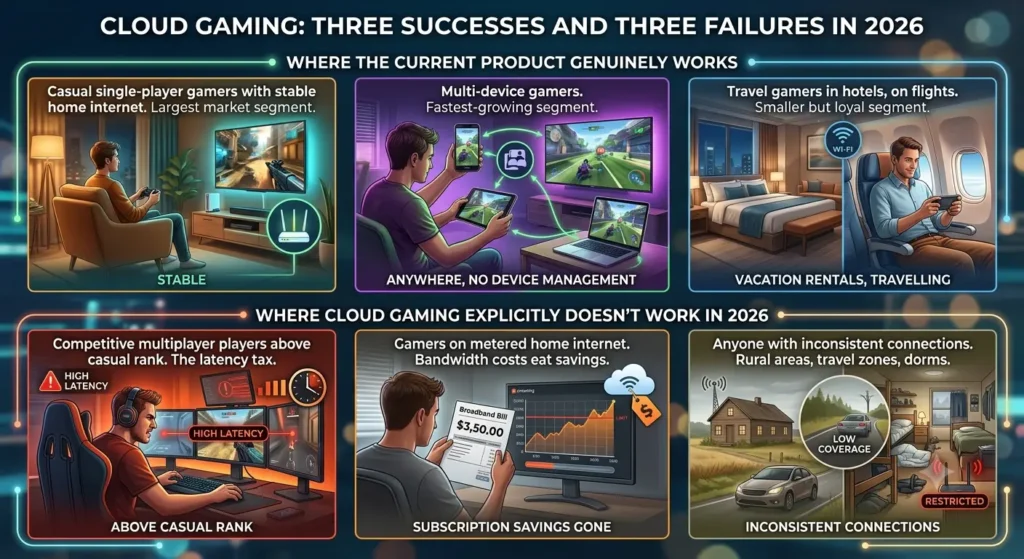
Three buyer types where the current product genuinely works:
- Casual single-player gamers with stable home internet who don’t want to maintain hardware. The biggest current market segment.
- Multi-device gamers who play on phone, tablet, TV, work laptop, and personal PC — and want their library available everywhere without device management. The fastest-growing segment.
- Travel gamers who play in hotels, on flights with decent wifi, or at vacation rentals. Smaller but loyal segment.
Three buyer types where cloud gaming explicitly doesn’t work in 2026:
- Competitive multiplayer players above casual rank. The latency tax is real.
- Gamers on metered home internet. Bandwidth costs eat the subscription savings.
- Anyone with inconsistent connections (rural areas, frequent travel through low-coverage zones, dorms with restricted internet).
The framing that matters: cloud gaming is currently the second screen of the gaming industry, not the primary one. Most people who use it also own a primary device. The “no local hardware” thesis from 2018-2019 was wrong; the “cloud gaming is irrelevant” reaction was equally wrong.
The 3 leading cloud gaming services compared
| Service | Library model | Monthly price | Top streaming spec | Best for | Trade-off |
|---|---|---|---|---|---|
| Xbox Cloud Gaming (Game Pass Ultimate) | Subscription-bundled catalogue | $20 | 1080p/60fps | Discovering new games without buying | Library rotates; titles can disappear |
| GeForce Now | Stream games you already own | $10-$20 (tiered) | 4K/120fps (Ultimate) | Best technical experience; full PC library | You still buy games separately |
| PlayStation Plus Premium | Curated PS streaming catalogue | $18 | 1080p/60fps | PS-exclusive AAA streaming | Smallest library; tied to Sony ecosystem |
| Amazon Luna | Subscription tiers + Prime perks | $5-$18 | 1080p/60fps | Casual play within Prime ecosystem | Library breadth lags the leaders |
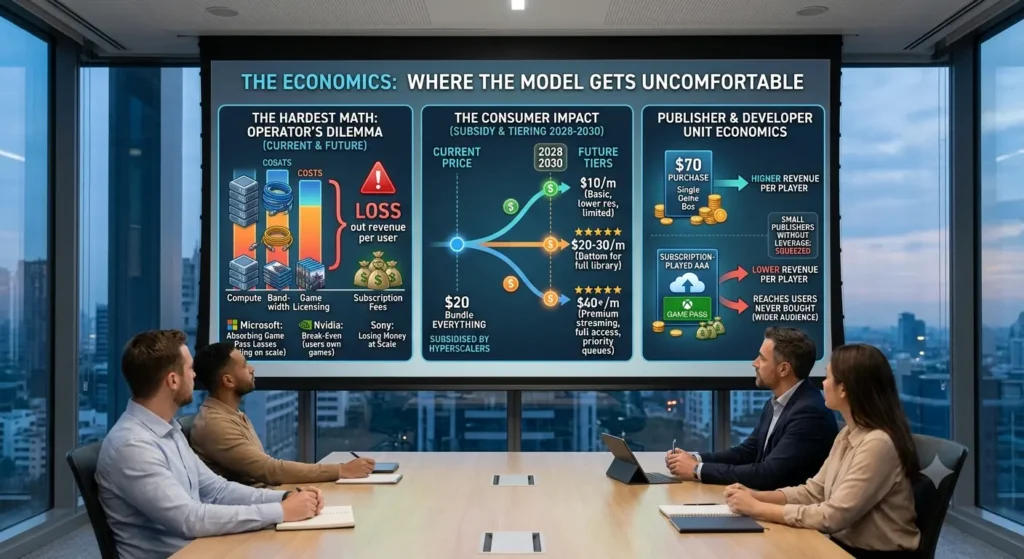
The economics (where the model gets uncomfortable)
The honest math for the subscription operators is harder than it looks. Compute, bandwidth, and game licensing costs add up to materially more per active user than the subscription revenue covers at current pricing. Microsoft has publicly absorbed Game Pass losses for years, betting on long-term scale. Nvidia runs GeForce Now closer to break-even because users pay for their own games. Sony’s cloud business loses money at scale.
For consumers, this means current pricing is subsidised by hyperscale operators and won’t necessarily hold forever. The realistic 2028-2030 picture: tiered pricing that ranges from $10/month (basic, lower resolution, limited library) to $40+/month (premium streaming, full library access, priority queues). The $20-bundles-everything tier is probably already at the bottom of where it lands.
For publishers and developers, cloud gaming changes the unit economics in ways the industry is still figuring out. A single subscription-played AAA generates less revenue per player than a $70 purchase but reaches users who would never have bought the game. The trade-off works for some titles and not others. Smaller publishers without subscription-deal leverage continue to get squeezed.
What would have to be true for cloud gaming to actually replace local hardware
Five conditions, in order of how close each is to landing:
- Latency parity for competitive multiplayer — still 30-60ms+ above local on the best setups; closing this requires both edge-compute density and meaningfully better encoding. Probably 2028-2032 timeframe.
- Unmetered home internet as default — happening slowly in some markets, not at all in others. The economics matter less for casual users; this matters more for heavy users.
- Pricing that hyperscale operators can sustain without subsidy — probably means $30-$40/month for premium tiers, not the current $20.
- Library control that consumers trust — Game Pass titles disappearing has been a real friction point. Subscription consumers tolerate this more than purchase consumers, but it shapes loyalty.
- A genuine flagship moment — a major title launching cloud-first or cloud-exclusive that becomes a cultural event. Hasn’t happened. May never happen.
None of these are technically impossible. None of them are happening fast. The cumulative picture: cloud gaming continues growing as a secondary modality through 2030, with primary-device gaming still dominant.
What this means for gamers in 2026
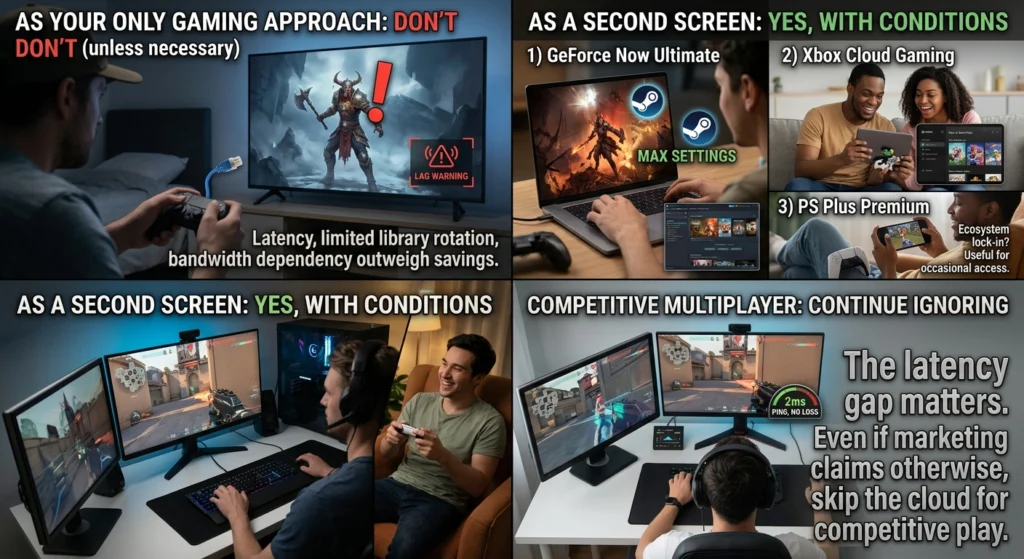
If you’re considering cloud gaming as your only gaming approach: don’t, unless you specifically can’t justify hardware. The compromises (latency, library rotation, bandwidth dependency) outweigh the savings for most use cases.
If you’re considering cloud gaming as a second screen: yes, with conditions. GeForce Now Ultimate gives you the best technical experience and lets you keep your existing Steam library. Xbox Cloud Gaming (bundled with Game Pass Ultimate) gives you discovery breadth. PS Plus Premium makes sense if you’re already inside the PlayStation ecosystem and want occasional cloud access.
If you’re a competitive multiplayer player: continue ignoring cloud gaming. The latency gap matters at your skill level, even when marketing pages claim otherwise.
For broader context on where the gaming industry is heading, see our recent coverage of the next decade in gaming and the top gaming gadgets in 2026.
What to watch over the next 12-24 months
- 6G rollout in major US/EU metros. If carriers deliver on 6G’s latency promises (sub-10ms in optimal conditions), the cloud-for-competitive thesis recovers.
- Microsoft’s Game Pass Cloud pricing changes. If the bundled-cloud tier becomes separately priced (or rises substantially), it signals operator economics are forcing the issue.
- A major title launching with cloud-first availability. Would be the inflection point the category has been waiting for.
- GeForce Now’s library expansion. If more publishers (specifically Take-Two, EA at scale, Activision under Microsoft) license their full libraries, the value proposition shifts meaningfully.
- Chinese cloud gaming reaching the West. Tencent and NetEase have years of cloud experience inside China; international expansion would change the competitive landscape overnight.
The cloud gaming era didn’t arrive in 2019 like Stadia promised. It also didn’t disappear after Stadia died. The actual 2026 reality is more nuanced — three real services, a clear value proposition for specific use cases, real technical and economic obstacles that haven’t gone away. The 2030 picture probably looks more like “cloud as the second screen” than “cloud as the only screen.” That’s still a meaningful shift, just not the revolution the marketing pages keep predicting.
FAQ
Is cloud gaming actually good in 2026?
It depends on the use case. For casual single-player gaming on stable home internet, yes — services like GeForce Now Ultimate and Xbox Cloud Gaming deliver genuinely playable experiences. For competitive multiplayer, the 30-60ms latency overhead remains a real handicap. For travel gaming on inconsistent connections, the experience can range from great to unplayable.
Will cloud gaming replace consoles by 2030?
No. Cloud gaming will continue growing as a secondary modality — a way to access your library on phones, tablets, and travel devices — but most serious gamers will still own a primary console or PC in 2030. The “no local hardware” prediction from 2018-2019 was wrong, and remains wrong on a 5-year horizon.
What’s the best cloud gaming service in 2026?
For best technical performance: GeForce Now Ultimate (4K/120fps, streams games you already own). For best library variety bundled with a subscription: Xbox Cloud Gaming via Game Pass Ultimate. For PlayStation-exclusive access: PS Plus Premium. The “best” depends on what you already own and what library breadth you want.
How much internet bandwidth does cloud gaming use?
1080p/60fps streaming uses 15-25 Mbps sustained, roughly 50-150GB per hour. 4K/60fps uses 35-50 Mbps sustained, 250-500GB per hour. A daily 2-hour 1080p session burns about 100GB/day — well above most ISP “1TB monthly cap” plans without overage fees. Bandwidth-cap households need to factor this into the cost calculation.
Why did Google Stadia fail?
Stadia launched in 2019 with a confused business model (consumers paid for the service and for individual games at full price), limited library, no real flagship titles, and Google’s typical reputation for shutting down services. Google closed Stadia in January 2023 after reported losses of roughly $1.5B. The technology was genuinely good; the business case and launch strategy were not.
Can you play competitive multiplayer games on cloud gaming?
Casually yes, competitively no. The 30-60ms latency overhead on top of normal network latency is felt by any player above casual ranks in games like Fortnite, Valorant, Apex Legends, and Counter-Strike. For pure casual play, the experience is fine. For ranked competitive, local hardware remains meaningfully better.
How does cloud gaming pricing work in 2026?
Three pricing models: subscription-bundled-with-catalogue ($18-$20/month, Xbox Game Pass Ultimate or PS Plus Premium), subscription-streams-games-you-own ($10-$20/month tiered, GeForce Now), and Prime-bundled-tiers ($5-$18/month, Amazon Luna). The economics suggest current pricing is subsidised — expect premium tiers to drift toward $30-$40/month by 2028-2030 as operators chase profitability.
Is cloud gaming better than buying a console?
For most serious gamers, no — a $749 PS5 Pro plus an OLED TV will deliver a meaningfully better experience than any cloud setup at current technology levels. For casual gamers who don’t want to maintain hardware, cloud subscriptions can be the better choice. The break-even depends on how much you play, what genres you prefer, and how stable your internet is.
Want sharper coverage of gaming, console economics, and the technology shaping how we actually play? Subscribe to the TechDaily360 weekly briefing for the next dispatch.