


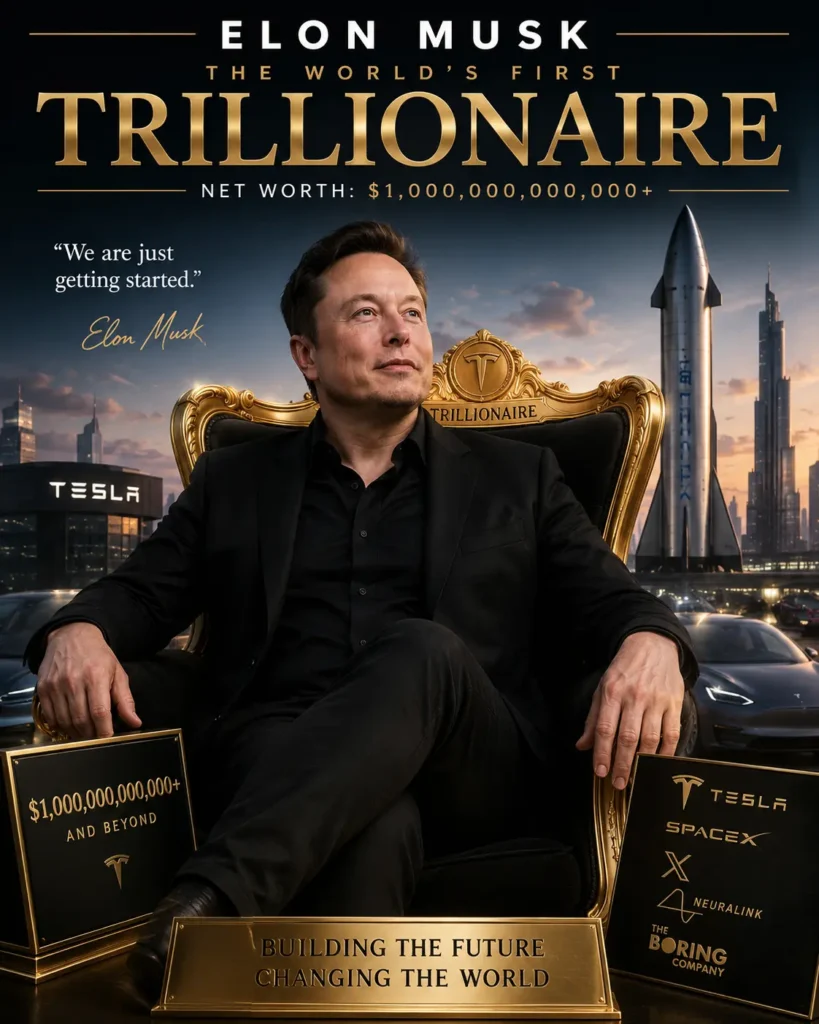
Elon Musk’s net worth crossed $1 trillion on Thursday, June 12, 2026 — the same morning SpaceX began trading on the Nasdaq under the ticker SPCX at an opening price of $135 per share, valuing the company at $1.77 trillion (CNBC, CBS News, Washington Post).
He is the first documented person in history to hold a paper net worth above $1 trillion.
For most people, that headline is the story. For anyone trying to read where the next wave of AI capital is going, the SpaceX IPO is also a funding event — and a large fraction of the proceeds will flow into Musk’s AI estate.
What actually happened
SpaceX listed at a $1.77 trillion fully-diluted valuation. Musk owns approximately 42% of SpaceX — roughly 4.8 billion shares — which placed his SpaceX stake alone at ~$866 billion at the IPO price.
Combined with his Tesla holdings, xAI equity, and stakes in The Boring Company and Neuralink, that pushed total net worth above the trillion-dollar line for the first time. Bloomberg’s Billionaires Index put Thursday’s number at $971 billion; Forbes went higher at $1.2 trillion. The gap is mostly methodology: Bloomberg discounts private holdings more aggressively than Forbes does.
Either way, SpaceX intraday hit a high of $168.75, pushing Musk’s paper wealth as high as $1.18 trillion before settling.
The wealth ladder, compressed
A timeline of Musk’s net worth across the last twelve months tells the story of how fast this happened (Wikipedia: Wealth of Elon Musk):
| Date | Net worth (estimate) | Catalyst |
|---|---|---|
| October 2025 | $500B | Tesla AI Day momentum, Starlink revenue surge |
| December 2025 | $600B → $700B | Year-end Tesla rally + SpaceX secondary tender |
| February 2026 | $800B | xAI funding round at higher valuation |
| Pre-IPO (June) | $982.6B | Forbes estimate before SPCX trading |
| June 12, 2026 | $1.0T+ | SpaceX IPO |
Why it matters: the doubling from $500B to $1T happened in eight months. That cadence is not normal even by Musk standards. The drivers — SpaceX dilution-event valuation, Tesla’s AI narrative repricing, and xAI’s secondary-market mark-ups — all hit in the same window.
Where the SpaceX cash actually goes
A public SpaceX matters because it makes Musk’s private war chest visible and partially liquid. He has been explicit about three deployment targets:
- xAI / Colossus — the Memphis supercomputer cluster that trains Grok. Musk has said publicly he wants to push it from ~100k Nvidia H100/H200 GPUs to 1 million accelerators by 2027. That is a multi-tens-of-billions capex commitment that the SpaceX IPO comfortably funds.
- Tesla Optimus — the humanoid robot program that Musk has framed as Tesla’s largest long-term revenue line. Optimus is fundamentally an AI bet: the model behind the robot is what makes (or breaks) the unit economics.
- Starship cargo to support Starlink V3 — Starlink is already SpaceX’s revenue engine. V3 satellites need Starship to scale. The IPO partly underwrites that.
For AI-watchers, the first one is what to track. xAI sat at a roughly $80 billion valuation in the most recent secondary round. A capital-flush Musk could push that to $150–200B in twelve months — and would reshape the Anthropic / OpenAI / Google three-way race into a four-way fight much faster than the rest of the market is pricing.
How Musk stacks up against the rest
The trillionaire line is symbolic. The structural story is the gap that just opened (Forbes Real-Time Billionaires):
| Billionaire | Net worth | Source of wealth |
|---|---|---|
| Elon Musk | $1.0–1.2T | SpaceX 42%, Tesla, xAI, Boring, Neuralink |
| Bernard Arnault | ~$235B | LVMH |
| Jeff Bezos | ~$220B | Amazon, Blue Origin |
| Larry Ellison | ~$195B | Oracle, Tesla shares |
| Mark Zuckerberg | ~$180B | Meta |
| Bill Gates | ~$130B | Microsoft, Cascade Investments |
Musk is now roughly 4–5x ahead of the next-richest person. That is the widest gap in the modern history of the Forbes list, and it is almost entirely concentrated in two private companies (SpaceX, xAI) and one heavily-AI-narrative public one (Tesla).
The xAI question, sharpened
Investors who care about AI infrastructure should be watching xAI’s next valuation event, not the trillionaire headline. Three signals to track:
- Colossus GPU count public disclosure. Musk has hinted at it; an actual press release with a verified Nvidia ship number would force OpenAI, Anthropic, and Google to disclose comparable figures.
- xAI revenue from API and Grok subscriptions. Currently obscured inside private financials. The SpaceX IPO sets a precedent for eventually doing the same with xAI.
- Grok model release cadence. Grok 4 shipped on benchmarks competitive with GPT-5 and Claude Fable 5. The next release will tell us whether the GPU lead is translating into model lead.
For more context, see our coverage of Claude Fable 5 and the AI economics debate.
What this changes for AI talent and infra spend
Two practical shifts to expect over the next four quarters:
- AI engineering hiring at xAI accelerates. A founder with $200–300B of fresh fungible capital can offer compensation packages no other lab can match. Watch for senior departures from OpenAI, Anthropic, and Google DeepMind toward xAI through Q3.
- Nvidia gets a single-customer concentration problem — again. Nvidia’s most recent 10-Q showed three clients driving more than half of revenue. xAI is one of those three. A trillionaire-funded xAI tilts the concentration risk even further.
Neither of these is good for the rest of the AI ecosystem. Both are good for Musk’s competitive position in AI specifically.
What the milestone does not change
A few honest caveats worth stating:
- Paper wealth is paper wealth. SpaceX shares are not freely tradeable for Musk on day one — IPO lockups limit how much he can monetise. The trillion-dollar number is a market-cap projection, not a bank balance.
- Net worth can compress fast. Tesla’s most recent compensation package conditions large grants on operational milestones. Missing them would compress the number more than most observers expect.
- The “first trillionaire” framing flatters Musk specifically. Aggregate wealth concentration above a trillion dollars exists across multiple families and sovereign wealth funds. The trillionaire line is about one individual on a public list.
What to watch next
- xAI’s next funding round valuation. A jump from $80B to $150B+ in the next two quarters would confirm the capital pipeline is flowing.
- Tesla earnings commentary on Optimus. Specifically: any quantified unit shipment target with a date attached.
- SpaceX 6-month and 12-month lockup expirations. When and how much Musk sells will signal where he is actually deploying cash.
- Whether Bezos or Zuckerberg cross $1T next. Bezos has SpaceX exposure via Blue Origin’s much-smaller equity story; Zuckerberg’s wealth tracks Meta stock plus the Reality Labs AI bet. Neither is close, but the line is no longer notional.
The trillionaire headline is going to dominate for a week. The actual story is what gets built with the capital. For the AI sector specifically, the gap between xAI and the rest of the frontier is about to narrow much faster than the consensus expects.
FAQ
What made Elon Musk a trillionaire?
The SpaceX IPO on June 12, 2026. SpaceX listed under the ticker SPCX at $135 per share, valuing the company at $1.77 trillion. Musk’s roughly 42% stake — about 4.8 billion shares — was worth ~$866 billion at the IPO price, pushing his combined net worth above $1 trillion.
Is Musk’s net worth really $1 trillion, or is it on paper?
On paper. Bloomberg’s Billionaires Index reported $971B; Forbes went higher at $1.2T. The gap is methodology — Bloomberg discounts private holdings more. Either way, SpaceX intraday hit $168.75 and pushed his paper wealth to $1.18 trillion.
What is the ticker symbol for SpaceX?
SPCX. SpaceX began trading on the Nasdaq on June 12, 2026 at an opening price of $135 per share.
How does Musk’s wealth compare to other billionaires?
Roughly 4–5x ahead of the next-richest person. Bernard Arnault (LVMH) is at ~$235B; Jeff Bezos at ~$220B; Larry Ellison at ~$195B. The gap is the widest in the modern history of the Forbes list.
What about xAI and Grok in this story?
A significant share of the SpaceX-IPO cash is expected to flow into Musk’s AI estate — xAI / Grok / Colossus. Musk has publicly signalled he wants to push the Memphis supercomputer cluster from ~100k Nvidia accelerators to ~1 million by 2027.
How fast did Musk’s wealth grow to this level?
Very fast. October 2025 was $500B. June 2026 is $1T. The doubling happened in eight months. The drivers were SpaceX dilution-event valuations, Tesla’s AI-narrative repricing, and xAI’s secondary-market mark-ups.
Does this affect Tesla shareholders?
Indirectly. Musk’s Tesla compensation package conditions large equity grants on operational milestones. A SpaceX-funded Musk can underwrite Optimus and AI compute commitments that benefit Tesla without needing to sell Tesla shares.
What should AI investors actually watch next?
Three signals: xAI’s next funding-round valuation, Tesla’s Optimus shipment guidance, and SpaceX lockup-expiration sales. None of those are about the trillionaire headline. All of them tell you where the capital actually deploys.
Track the AI-capex story as it lands each week — subscribe to the TechDaily360 weekly briefing.