


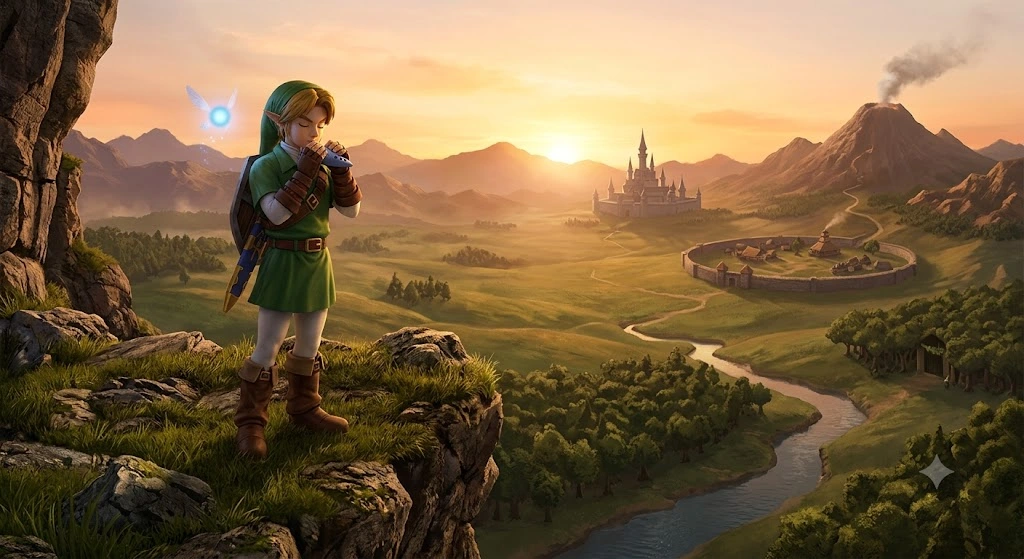
The rumor that wouldn’t die is finally real. After months of leaks, podcast whispers, and the kind of “trust me bro” insider chatter that usually goes nowhere, Nintendo pulled the curtain back at the June 9 Nintendo Direct and confirmed it: The Legend of Zelda: Ocarina of Time is being remade for Nintendo Switch 2, launching later in 2026.
There’s no exact date yet. There’s almost no gameplay shown. There’s barely even a logo reveal. But the most influential 3D game ever made is officially coming back, rebuilt for modern hardware, and the internet has predictably lost its mind.
Here’s everything we actually know, everything fans have been asking, and why this announcement matters more than the short teaser made it look.
What Was Just Announced?
During Nintendo’s summer Direct, the company aired a quiet, almost meditative trailer set against a tapestry-style mural of Hyrule. A narrator describes the Kokiri children, each born with a fairy companion, and the one boy who wasn’t. The shot fades to a sleeping young Link in his treehouse. The Triforce mark glows softly on the back of his hand. A new logo appears — the same Master Sword and Hylian Shield silhouette as the 1998 box art, but in gold this time instead of red.
That’s it. No combat. No Hyrule Field. No Ganondorf. Just vibes.
Nintendo’s full statement was about as short as you’d expect: the N64 classic is being “reborn” exclusively for Switch 2, with more details promised later in the year. There’s no studio credit yet, no price, no specific release window beyond “2026.”
What we can say with confidence is that this is a full remake, not a remaster. The 2011 port on 3DS, Ocarina of Time 3D, was a touched-up version of the original assets. This appears to be something else entirely — rebuilt from the ground up, likely using a modern engine. Several insiders have floated the idea that it’s running on a derivative of the Breath of the Wild / Tears of the Kingdom engine, though Nintendo hasn’t confirmed that.
The timing is no accident. Zelda turned 40 earlier this year, and a live-action Zelda movie is set for May 2027. A remake of the franchise’s most celebrated entry slots neatly into that anniversary push.
A Quick Refresher: Why Ocarina of Time Still Matters
If you’re under 25, it’s genuinely hard to overstate what this game did. Ocarina of Time launched on November 21, 1998, on the Nintendo 64. It still holds a Metacritic score of 99 — the highest of any game on the site — and it routinely tops “best games ever made” lists more than two decades later.
The Game That Rewrote the Rules for 3D Adventure
Before Ocarina, 3D action games were rough. Cameras were nightmares. Combat was a swing-and-pray exercise. Designers were still figuring out how to translate the precision of 2D Zelda into a 3D space.
Then Ocarina shipped with Z-targeting — a lock-on system that let you circle, sidestep, and counter enemies without losing your camera. Almost every 3D action game since, from Devil May Cry to Dark Souls to Elden Ring, owes something to that single design decision. Add in context-sensitive button prompts, a sprawling overworld you could ride a horse across, and a time-travel hook that let you experience Hyrule as both child and adult, and you have a game that taught the industry how 3D adventures were supposed to work.
Why It Became a Legend
It wasn’t just the mechanics. Ocarina hit a tonal sweet spot that almost no game has matched since. The Lost Woods music is sad. The Hyrule Field theme is hopeful. Ganondorf’s cackle is genuinely unsettling. The transition where Link pulls the Master Sword and ages into an adult while Hyrule falls into ruin around him is one of the most memorable narrative beats in any game ever — and it lands in about thirty seconds of cutscene.
That emotional weight is why the remake announcement landed the way it did. People aren’t excited about prettier polygons. They want to feel that twelve-year-old-kid feeling again.
Why Fans Wanted an OoT Remake So Badly
A vocal slice of the Zelda fanbase has been begging Nintendo for this for almost a decade. The pressure built up for three reasons.
Modern Graphics That Do the World Justice
Take a look at any of the Unreal Engine fan recreations of Ocarina of Time floating around YouTube. Hyrule Field with proper grass, a sun that actually sets, water that reflects the sky — the game’s world was always grand in imagination, but the N64 could only suggest so much of it. A modern engine can deliver the version of Hyrule that lived in players’ heads in 1998.
Quality-of-Life Improvements That Are Long Overdue
The original Ocarina hasn’t aged perfectly. Some things are genuinely creaky:
- The Iron Boots being a regular inventory item instead of a button (anyone who’s played the Water Temple knows the pain)
- The lack of a proper map for some dungeons
- Inventory management that requires pausing constantly
- A camera that occasionally has opinions you didn’t ask for
The 3DS version fixed some of this. A Switch 2 remake has the chance to fix all of it.
Preserving What Made the Original Special
Here’s the catch, though, and it’s the part Nintendo will have to handle carefully: people don’t actually want a different game. They want the same game, made beautiful. Modernize the controls. Improve the camera. Add voice acting if you must (the trailer’s narration suggests it’s coming). But touch the puzzle design and the level layouts at your own peril. There’s a reason Resident Evil 4’s remake was praised and other remakes have been roasted — fidelity to what made the original sing matters more than the visual upgrade.
What an Ocarina of Time Switch 2 Release Could Look Like
Nintendo hasn’t shown gameplay, but the Switch 2 hardware gives us a reasonable sense of what’s possible. The console is dramatically more powerful than the original Switch, supports 4K output when docked, and handles modern rendering techniques the N64 couldn’t dream of.
Here’s what’s plausible for the Switch 2 version, based on what the hardware can do and what comparable Nintendo remakes have included:
- 4K visuals when docked, with high frame rates (likely 60fps, possibly more)
- Reworked lighting and weather systems in the spirit of Tears of the Kingdom
- Faster loading thanks to the Switch 2’s SSD
- Updated character models with expressive faces instead of N64 polygon blocks
- Optional voice acting — the trailer’s narration is a strong hint
- Refined controls mapped to the Joy-Con 2, including likely use of the new mouse-mode for menus
- HD Rumble support for the ocarina playing, sword strikes, and dungeon mechanics
There’s also been chatter — unconfirmed — about a Zelda-themed Switch 2 limited edition console releasing alongside the game. Given Nintendo’s track record with hardware tie-ins (the Skyward Sword Switch, the OLED Tears of the Kingdom edition), this would be on-brand.
Could It Drop in November?
The original Ocarina launched in November 1998. The Zelda 40th anniversary year ends in February. A November 2026 release would mirror the original date and let Nintendo own the holiday quarter — which, notably, is the same window Rockstar is targeting with Grand Theft Auto 6 on other platforms. Nintendo doesn’t usually flinch from competition. A November 2026 launch makes a lot of strategic sense.
Is Ocarina of Time the Hardest Zelda Game?
Short answer: no, not really.
The hardest Zelda is probably Zelda II: The Adventure of Link, with its arcade-style side-scrolling combat and brutal experience-loss penalties. Majora’s Mask arguably edges out Ocarina on dungeon complexity, and Breath of the Wild on Master Mode can be punishing if you wander into the wrong region too early.
What Ocarina has is dungeon density. Each temple is a layered puzzle that demands you hold a mental model of the whole space in your head. The Water Temple, especially in its original N64 form, asks you to track water levels across multiple floors while constantly swapping the Iron Boots in and out of your inventory. It’s not unfair, but it’s not forgiving either.
So is it the hardest Zelda? No. Is it the most mentally demanding if you go in cold and without a guide? Probably yes.
Why Is OoT So Hard for New Players?
This question shows up a lot, and the answer comes down to expectations more than mechanics.
Modern games hand-hold. You get quest markers, objective highlights, glowing paint on the wall you’re supposed to climb, and an NPC who reminds you what to do every time you reopen the game. Ocarina has almost none of that. Navi will occasionally pipe up with a “Hey, listen!” hint, but the game largely expects you to figure things out by paying attention.
That’s not “hard” by 1998 standards. It’s only hard relative to what gaming has become. The dungeons also demand backtracking — you’ll need an item from one wing to access another, and the game won’t tell you where to go next. For players raised on linear progression, that can feel like being lost. For players who grew up on it, it feels like freedom.
The Switch 2 remake will likely soften some of these edges with optional hint systems, the way the 3DS version did with the Sheikah Stones.
Is Navi a Boy or a Girl in Ocarina of Time?
Navi is a fairy. Fairies in Hyrule aren’t really gendered the way humans are, but Navi is referred to with female pronouns in the English version of the game and in most official Nintendo materials. Her voice clips are higher-pitched and her personality reads as broadly feminine. So: Navi is generally treated as female.
She’s also one of the most memed characters in gaming history. The “Hey! Listen!” voice line has been the subject of two decades of jokes, despite Navi being significantly less annoying than the internet remembers. (She really only speaks up when you’ve been stuck for a while. The legend is bigger than the reality.)
If voice acting comes to the Switch 2 remake, how they handle Navi is going to be one of the more interesting creative choices. Lean into the iconic “Hey! Listen!” or tone it down for a more grown-up presentation? We’ll find out.
How to Beat Ocarina of Time: A Quick Roadmap
If you want to refresh your memory before the remake drops, here’s the broad shape of the journey. No spoilers on plot beats, just structure.
Child Link arc:
- Wake up in Kokiri Forest, get the Kokiri Sword and the Deku Shield
- Clear the Inside the Deku Tree dungeon
- Travel to Hyrule Castle, meet Princess Zelda
- Visit Death Mountain and clear Dodongo’s Cavern
- Head to Zora’s Domain and clear Inside Jabu-Jabu’s Belly
- Return to the Temple of Time and pull the Master Sword
Adult Link arc:
- Forest Temple (Sacred Forest Meadow)
- Fire Temple (Death Mountain Crater)
- Water Temple (Lake Hylia) — the famous one
- Shadow Temple (Kakariko Graveyard)
- Spirit Temple (Desert Colossus) — partly accessed as child Link
- Ganon’s Castle and the final showdown
Beginner tips for the remake:
- Collect heart pieces aggressively. Four pieces equals one full heart container.
- Upgrade your wallet and quiver as early as you can.
- Learn songs as you get them, even ones that seem optional — they’ll all come back.
- Don’t skip side content in Hyrule Field. The Poe-collecting and bug-hunting hide some of the best rewards.
If the remake adds difficulty options the way modern games do, expect a Hero Mode or hard difficulty to be added either at launch or in a patch.
What an Ideal Switch 2 Remake Should Include
Here’s the wishlist. Some of this is realistic, some is dreaming, all of it would land well with the fanbase.
Graphics overhaul that respects the original art direction. Don’t go full photo-real. Ocarina has a slightly storybook quality to it. The trailer’s tapestry framing suggests Nintendo gets that.
Expanded world detail. Castle Town should feel like a town, not seven NPCs in a circle. Hyrule Field should reward exploration with more than just bushes to cut.
Improved controls and camera. A modern right-stick camera is non-negotiable. So is mappable Iron Boots.
Optional classic mode. Some players will want the original difficulty curve and item rules. Give them a toggle.
Switch 2 enhancements that actually use the hardware. HDR. 4K docked. 60fps target. Mouse-mode for menus. Quick resume between sessions.
Don’t touch the music. Koji Kondo’s score is sacred. Re-record it with a live orchestra by all means — but don’t replace it.
What This Means for Nintendo and the Switch 2
Strategically, this is a very Nintendo move. The Switch 2 launched strong, but its second-year lineup needs heavy hitters to keep momentum against everything coming from PlayStation and PC. A remake of the most acclaimed game of all time, in the franchise’s 40th-anniversary year, on the company’s brand-new console — that’s about as commercial-slam-dunk as it gets.
It’s also a smart way to celebrate Zelda’s 40th without burning a mainline release. The next big “new” Zelda is still presumably cooking. Ocarina fills the gap and gives the studio behind it time to deliver.
For fans, the practical question is: which version do you wait for? Ocarina of Time is currently playable on Switch and Switch 2 via the Nintendo Switch Online Expansion Pack, which gives you the original N64 build. If you’ve never finished it, that version is right there. If you want the definitive experience, the 2026 remake is the one to wait for.
The Bottom Line
The Ocarina of Time remake has been a meme for so long that it’s strange to write a sentence where it’s actually real. But here we are. Nintendo confirmed it, gave it a 2026 window, and showed just enough to convince anyone who grew up with the game that they understand the assignment.
We don’t know who’s making it. We don’t know exactly when it ships. We don’t know what’s been changed and what’s been preserved. But we know it’s coming, on Switch 2, this year. After almost three decades, the boy from the forest who didn’t have a fairy is heading back to Hyrule — and a generation of players is about to find out whether the memory lives up to the reality.
Stay tuned. There’s almost certainly a dedicated Zelda Direct on the horizon, and that’s where the real reveal happens.
Frequently Asked Questions
Is Ocarina of Time the hardest Zelda game? No. Zelda II is generally considered the hardest, and Majora’s Mask is more dungeon-complex. Ocarina is challenging but not the hardest in the series.
Why is OoT so hard for new players? The game expects you to explore, backtrack, and pay attention to environmental clues, with very little modern hand-holding. Once you adapt to its pace, it’s not unfair.
Is Navi a boy or a girl in OoT? Navi is generally treated as female in Nintendo’s official materials and the English localization.
How long does it take to beat Ocarina of Time? A typical first playthrough runs 25 to 35 hours. Speedrunners have finished it in under 4. Completionists routinely spend 40+ hours collecting heart pieces, gold skulltulas, and side content.
Will Ocarina of Time get a remake? Yes. Nintendo officially announced The Legend of Zelda: Ocarina of Time remake on June 9, 2026, exclusively for Nintendo Switch 2, releasing later this year.
Will Ocarina of Time come to Nintendo Switch 2? Yes. The remake is a Switch 2 exclusive launching in 2026. The original N64 version is also already available on Switch and Switch 2 through the Nintendo Switch Online Expansion Pack.
What makes Ocarina of Time so important in gaming history? It’s widely credited with defining the template for 3D action-adventure games — introducing Z-targeting (now lock-on combat in countless games), a fully realized 3D overworld, and emotionally resonant storytelling. It holds a Metacritic score of 99, the highest of any game on the site.