



Most tech startups don’t fail because the idea was wrong. They fail because the founders treated two completely different stages of company-building like the same job. Idea-stage thinking applied to scale-stage problems will kill a company faster than any competitor can. The opposite — scale-stage discipline applied to a company that hasn’t found product-market fit — kills it just as cleanly.
This is the honest map of the seven stages every tech startup actually moves through, what each one is really for, the metric that signals you’re done with it, and the trap that takes out most of the companies that fail there. Whether the goal is a $50M outcome or a $5B one, the stages are the same. The mistakes founders make at each stage are also the same.

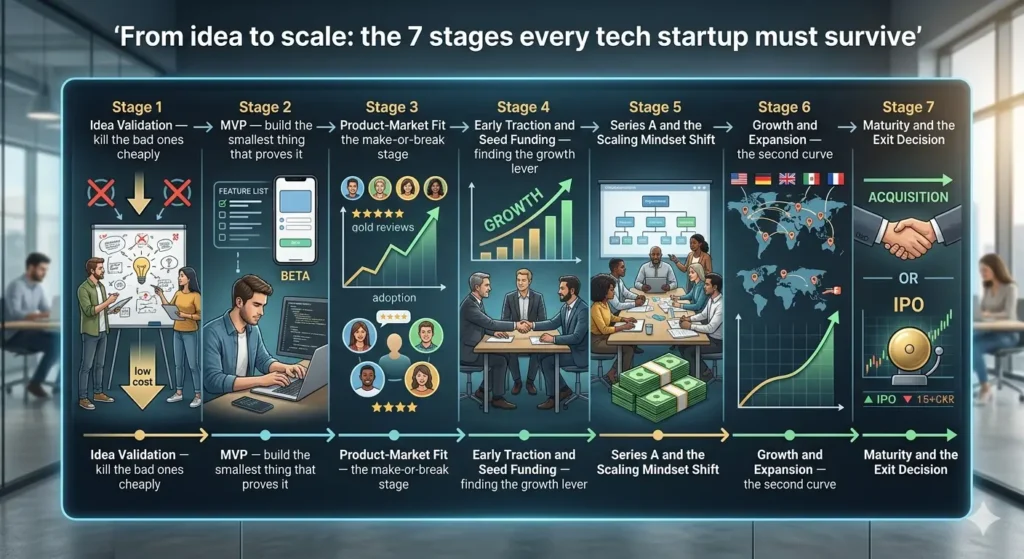
Stage 1: idea validation — kill the bad ones cheaply
Every founder thinks their idea is the exception. It isn’t. The job of stage 1 is to find out whether anyone other than you actually has the problem you think they have — and to do it before writing a single line of production code. The cost of skipping this is the cost of building something nobody wants.
Cheap validation looks like 30 customer conversations, a no-code landing page testing willingness to pay, or a manual “fake-it” service delivered by hand to ten paying users. Y Combinator’s advice on talking to users is still the canonical reference here. The output of stage 1 isn’t a prototype — it’s conviction that the problem is worth solving.
Done-with-it metric: at least 10 unaffiliated people have said some version of “I’d pay for this today.” If they haven’t, the idea isn’t ready yet.
Where most teams die here: falling in love with the idea before validating it. Six months of dev work on an unvalidated hypothesis is six months that can’t be recovered.
Stage 2: MVP — build the smallest thing that proves it
The minimum viable product is not a small version of the final product. It’s the smallest possible artefact that lets real users complete the core value loop. Anything beyond that — settings pages, admin dashboards, polished onboarding — is procrastination disguised as engineering.
The 2026 reality is that an MVP that took six months in 2020 takes six weeks now. AI-assisted coding, no-code backends, and pre-built infrastructure have collapsed the timeline. The bar has moved with it: investors and customers both expect more polish faster than they did even three years ago.
Done-with-it metric: a small group of users (10–50) using the product unprompted, more than once a week. Not signups. Not waitlist. Repeat usage.
Where most teams die here: over-engineering. The instinct to build for scale before product-market fit kills more pre-seed companies than any market problem.
Stage 3: product-market fit — the make-or-break stage
This is the one. Roughly 70% of startups fail before reaching product-market fit, and almost all of them fail because they confused early usage with true fit. Real product-market fit isn’t subtle. It feels like the product is pulling itself out of your hands.
The honest signal: word-of-mouth growth, customers asking when they can pay you more, and a 40%+ score on the “how would you feel if you could no longer use this product” survey (the Sean Ellis PMF test). If none of those are happening, you don’t have fit yet — no matter what the early traffic looks like.
Done-with-it metric: unprompted user growth and customer pull strong enough that the constraint becomes capacity, not demand.
Where most teams die here: declaring fit too early. Founders raise on the strength of vanity metrics, hire ahead of real demand, and burn 18 months of runway scaling something that wasn’t actually working. This is the single most expensive mistake in startup-building.
Stage 4: early traction and seed funding — finding the growth lever
With real fit, the next job is finding the one or two channels that actually scale. Most early-stage companies have a dozen marketing experiments going and learn nothing from any of them. Focus matters more here than creativity.
The seed round usually funds this stage. As of 2026, the median seed round for a tech startup with real PMF runs $2.5M–$5M, typically at a $15M–$25M post-money valuation, per Carta’s H1 2026 funding data. The capital buys you 18–24 months to find a repeatable growth engine — one channel, two at most, that compounds.
Done-with-it metric: at least one growth channel with a clear, repeatable customer-acquisition cost (CAC), and customer lifetime value (LTV) at least 3× CAC.
Where most teams die here: spreading thin. Five mediocre channels never produce the same result as one great one. The founders who win at this stage cut ruthlessly.
Stage 5: Series A and the scaling mindset shift
The Series A used to be where the company “made it.” In 2026, it’s where the company stops being a startup and starts being a business. The mindset shift required here is the one most founders underestimate.
Series A rounds in 2026 are larger and harder to raise than they were five years ago. Typical Series A: $8M–$15M at $40M–$80M post-money, with investors expecting roughly $1M+ ARR and 3x+ year-over-year growth. The bar has risen meaningfully since the 2021 peak. Our coverage of the 2025–26 venture funding compression walks through the structural reasons.
Done-with-it metric: the company can deploy capital efficiently. CAC payback under 18 months. Net revenue retention above 100%. A real org chart, not a list of “everyone does everything.”
Where most teams die here: failing to build a real management layer. Founders who try to keep operating like a 10-person team at 50 people watch culture and execution unravel at the same time.
Stage 6: growth and expansion — the second curve
By stage 6, the company has a working product, a working go-to-market motion, and a real org. The job now is finding the second growth curve before the first one flattens. That usually means a new product, a new customer segment, a new geography, or all three.
This is where most companies discover their first business was easier than they realised. Expanding into a new market means re-running stages 3 and 4 inside an already-running business. The discipline that worked at $5M ARR rarely scales unchanged to $50M.
Done-with-it metric: more than 30% of new revenue coming from a product or market that didn’t exist 18 months ago.
Where most teams die here: premature international expansion. Companies that launch in five countries before they’ve nailed one usually retreat from four within two years. a16z’s analysis of post-Series-B growth failures is the cleanest read on this pattern.
Stage 7: maturity and the exit decision
Stage 7 isn’t an end — it’s a choice. The company has revenue, profitability (or a credible path to it), and real strategic optionality. The question becomes what comes next: IPO, strategic acquisition, PE buyout, or staying independent and compounding.
Each path has different demands. IPO requires public-market-grade financial discipline and a believable five-year growth story. Strategic acquisition requires a clean cap table and a real buyer thesis. Independence requires capital efficiency that lets the company run on its own cash flow without further dilution.
Where most teams die here: founder fatigue. Stage-7 work — board management, investor relations, regulatory load, talent retention at scale — is a completely different job from stages 1 through 5. Founders who don’t either re-tool or hand off the CEO seat often watch the company stall during the very stage that should produce the biggest outcome.
For more on how the late-stage exit landscape is shifting in 2026, see our piece on what the AI investment boom means for traditional startup exits.
The 7 stages compared at a glance
| Stage | Primary goal | Done-with-it metric | Typical funding | Where most teams die |
|---|---|---|---|---|
| 1. Idea validation | Confirm the problem is real | 10+ unaffiliated buyers say “I’d pay” | Bootstrapped | Building before validating |
| 2. MVP | Smallest artefact that delivers value | 10–50 users returning weekly | Friends & family / pre-seed | Over-engineering |
| 3. Product-market fit | Find the pull | 40%+ on Sean Ellis test; organic growth | Pre-seed / seed | Declaring fit too early |
| 4. Early traction | Find one repeatable growth channel | LTV ≥ 3× CAC | Seed ($2.5M–$5M) | Spreading thin across channels |
| 5. Series A & scaling | Build a real business | $1M+ ARR, 3× YoY, CAC payback <18mo | Series A ($8M–$15M) | No management layer |
| 6. Growth & expansion | New segments, new geographies | Multi-product or multi-market revenue | Series B+ ($25M+) | Premature international push |
| 7. Maturity & exit | IPO, acquisition, or profitable independence | Strategic optionality | Late-stage / public | Founder fatigue |
The pattern most founders miss
The most common mistake across all seven stages is treating them as if they have the same shape. They don’t.
- Stages 1–3 are search problems. The job is finding something true about the market.
- Stages 4–5 are build problems. The job is constructing a repeatable business around the truth.
- Stages 6–7 are manage problems. The job is allocating capital and people across a real organisation.
The skills that win at search lose at build. The skills that win at build lose at manage. The founders who successfully cross all three transitions are extraordinarily rare — which is why the venture model assumes most companies will swap CEOs or fail along the way. Knowing which stage you’re actually in is the cheapest way to make sure you’re solving the right problem.
What to watch in your own startup
- Are you treating your current stage as the previous one? Building product when you should be selling. Selling when you should be managing. The signal is usually obvious in hindsight; pay attention to it now.
- What is the single “done-with-it” metric you’re actually tracking? If you can’t name one, you don’t know what stage you’re in.
- Who on the team has been through the next stage before? Hire for the stage you’re about to enter, not the one you just left.
- What would the company look like one stage from now? If you don’t have a clear picture, the gap between intention and execution is going to bite you.
The seven stages aren’t a checklist. They’re a map. Most failed startups had decent ideas and capable founders — they just kept solving the wrong problem at the wrong moment.
FAQ
How long should each startup stage take?
There’s no universal timeline, but rough guides: stage 1 (validation) — 1–3 months; stage 2 (MVP) — 6 weeks to 6 months; stage 3 (PMF) — 12–24 months; stage 4 (early traction) — 12–18 months; stage 5 (Series A and scaling) — 18–36 months; stage 6 (growth/expansion) — 2–5 years; stage 7 (maturity) — open-ended. Stages 3 and 5 are typically the longest and most painful.
What’s the difference between an MVP and a prototype?
A prototype demonstrates the concept; an MVP is a working product real users actually use to get real value. A prototype answers “could this work?” An MVP answers “do people actually use this?” The distinction matters because too many founders ship a prototype, get polite feedback, and mistake it for product-market fit.
How do you know if you have product-market fit?
The clearest signal is unprompted growth — users telling other users without you asking. The most-cited quantitative test is Sean Ellis’s “how would you feel if you could no longer use this product?” If at least 40% of users say “very disappointed,” you likely have fit. Below that, you don’t.
How much money should I raise at the seed stage?
Enough for 18–24 months of runway, ideally 24. Median 2026 seed rounds for tech startups with real PMF land at $2.5M–$5M, but the right number depends on your burn rate and the milestones you need to hit. Raising too much can be as harmful as raising too little — it lowers urgency and inflates valuation in ways that hurt the next round.
Why do most startups fail at the product-market fit stage?
Because founders confuse early traction with real fit. Launch enthusiasm, friends-and-family signups, and PR coverage all create vanity metrics that look like fit but aren’t. Then the team raises a seed round, hires aggressively, and burns through capital scaling something that was never working. About 70% of startups die between stage 3 and stage 4 for this exact reason.
When should a startup hire its first VP of Sales or Engineering?
Generally when the founder physically cannot continue doing the job themselves and the company has clear, repeatable processes the new hire can execute against. Hiring senior leaders too early — before product-market fit or before a clear playbook exists — usually fails because there’s nothing for them to manage. The right timing is typically late stage 4 or early stage 5.
What’s the biggest difference between Series A in 2021 vs 2026?
The bar is materially higher. In 2021, a Series A could close on strong growth and a credible story. In 2026, investors typically expect $1M+ ARR, 3× year-over-year growth, healthy unit economics (CAC payback under 18 months, NRR above 100%), and a clear path to profitability. Round sizes are similar; the metrics required to earn them have roughly doubled.
Can a tech startup skip stages?
Realistically, no — but you can compress them. Strong founder-market fit can shorten stages 1 and 2 dramatically. A pre-existing audience or distribution advantage can compress stage 4. But every company still has to find product-market fit, find a repeatable growth channel, build a real management layer, and decide on an exit. Skipping any of those produces the failures that look obvious in retrospect.
Want sharper analysis on startup operations, funding, and scale? Subscribe to the TechDaily360 weekly briefing for the next dispatch.