


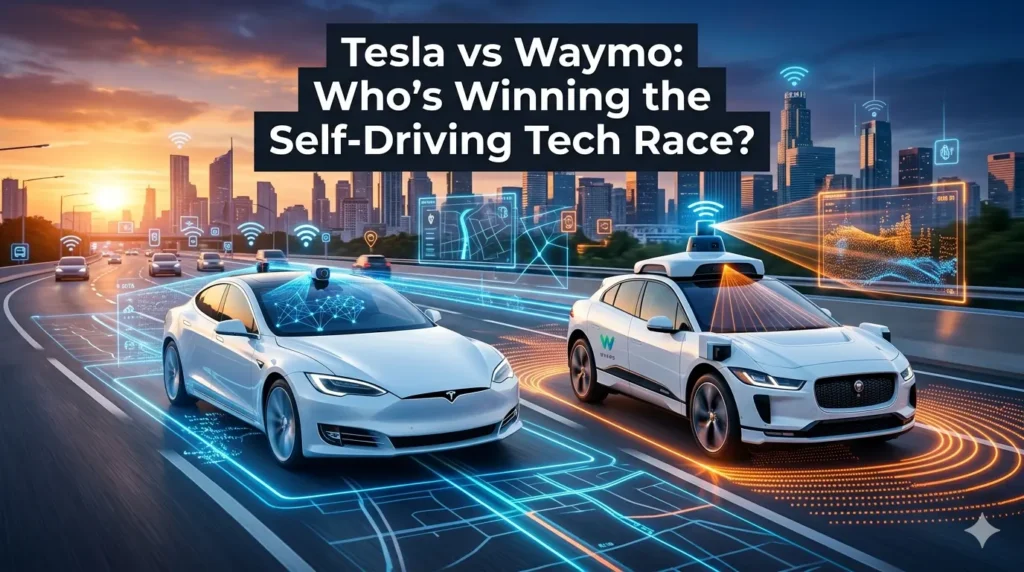
Self-driving cars stopped being science fiction roughly six years ago, and the field has settled into a two-horse race that looks nothing like a race at all. Tesla and Waymo are both chasing autonomy, but they’ve taken paths so different they’re barely solving the same problem. Tesla puts driver-assist tech into millions of consumer cars and learns from the road. Waymo runs a small fleet of fully driverless robotaxis in tightly mapped cities. Both call it “self-driving.” Only one actually drives itself. That gap is where the real story lives.
The basics: what Tesla and Waymo are actually offering
Tesla sells consumer vehicles with two layers of driver assistance — Autopilot (standard) and Full Self-Driving Supervised (paid add-on). Both still require a driver behind the wheel paying attention. Tesla classifies the system as SAE Level 2, which means human supervision is mandatory.
Waymo runs a commercial ride-hailing service called Waymo One, using fully autonomous vehicles with no human safety driver in the front seat. The cars operate at SAE Level 4 within geofenced service areas. You can’t buy one. You can only ride in one.
So which is “better” depends entirely on what you’re measuring — vehicles deployed, or actual hands-off driving delivered.
Tesla’s approach: Autopilot, FSD, and the data bet
Tesla’s strategy is volume. By shipping driver-assist hardware in every car since 2016, the company has built one of the largest real-world driving datasets on the planet. Tesla’s FSD page lists features including lane-keeping, traffic-aware cruise control, automatic lane changes, traffic-light recognition, and city-street navigation.
The bet underneath all of it: enough miles, enough video, and enough neural-network training will eventually produce true autonomy through over-the-air updates — no hardware swap required. Critics call this the “fake-it-till-you-make-it” path. Supporters call it the only way to scale.
There’s a real cost to the strategy. The NHTSA has opened multiple investigations into Autopilot- and FSD-related crashes, and the system has been involved in fatal incidents that Waymo’s fleet simply has not produced at scale. Whether the trade-off is worth it depends on whose miles you’re counting.
Waymo’s approach: fully autonomous ride-hailing
Waymo, an Alphabet subsidiary, took the opposite road. Instead of selling to consumers, it built a closed fleet of purpose-built robotaxis that combine LiDAR, radar, and cameras into a heavily redundant sensor stack. The vehicles operate without a human in the driver’s seat in select cities.
As of 2026, Waymo One serves Phoenix, San Francisco, Los Angeles, Austin, and is expanding into Atlanta and Miami through a partnership with Uber. Waymo’s own safety hub reports the fleet has crossed tens of millions of fully autonomous miles with significantly fewer injury-causing crashes than human drivers in equivalent areas.
The catch is reach. Waymo’s cars rely on high-definition pre-mapped routes, which means they can’t just drive anywhere. They drive very well exactly where they’ve been told to.
Technology behind the scenes: sensors and software
The sensor philosophy is the cleanest line dividing the two companies.
Tesla runs a “vision-only” stack — eight cameras feeding a custom neural network. The company dropped radar in 2021 and ultrasonic sensors in 2022, betting that cameras plus AI inference could match human perception.
Waymo uses a full sensor fusion stack — five LiDAR units, six radar units, and 29 cameras per vehicle. LiDAR uses laser pulses to build a precise 3D map of the surroundings, which gives the car depth information that cameras alone struggle to match in fog, glare, or rain.
Which is “better” is a real engineering debate, not just a marketing one. Cameras are cheaper and scalable; LiDAR is more robust and precise. Tesla’s argument is that humans drive with two eyes, so cameras should suffice. Waymo’s response is that cars don’t get tired and shouldn’t be limited to human-grade perception.
Tesla vs Waymo: the head-to-head comparison
| Factor | Tesla (Autopilot / FSD) | Waymo One | Why it matters |
|---|---|---|---|
| Autonomy level | SAE Level 2 (supervised) | SAE Level 4 (no driver) | Determines whether you can legally not pay attention |
| Sensor stack | 8 cameras only | LiDAR + radar + cameras | Affects performance in fog, glare, and edge cases |
| Where it works | Anywhere with road markings | Geofenced cities only | Tesla wins on reach; Waymo wins on capability |
| Who controls the car | Human driver, always | The car, fully | Insurance and liability sit in different places |
| Pricing | $8,000–$12,000 FSD add-on (2026) | Per-ride fare | Tesla is a capex; Waymo is opex |
| Fleet size | Millions of consumer vehicles | ~1,500 robotaxis (mid-2026) | Tesla collects more data; Waymo delivers more autonomous miles |
| Safety reporting | Limited public crash data | Detailed safety hub published | Transparency gap that regulators have noticed |
| Where it shines | Highway long-distance driving | Dense urban environments | Different problems, different winners |
Safety: how the two records actually compare
Tesla insists its data shows Autopilot-engaged miles are statistically safer than the US driving average. That comparison has been widely criticised — Autopilot is used mostly on highways, which are inherently safer per mile than city streets, so the math is generous.
Waymo’s safety record holds up better under scrutiny. The company’s 2024 transparency report showed roughly 81% fewer injury-causing crashes per million miles than human drivers in the same operating areas. Independent reviews by the IIHS and academic researchers have largely supported the claim.
The fair caveat: Waymo drives in controlled, mapped environments with conservative defaults. Tesla drives in everything. Comparing them directly is like comparing a chef in their own kitchen to a chef in a stranger’s house. Both matter. They are not the same job.
Real-world performance: where each one shines
Tesla performs best on highways. Adaptive cruise control, lane centering, and long-distance assistance are mature and reliable. The system has earned genuine loyalty from drivers who do significant highway mileage.
Waymo dominates dense urban environments. Busy intersections, unpredictable pedestrians, cyclists weaving in traffic, double-parked delivery vans — situations where humans hesitate, Waymo handles with calm consistency. The trade-off is that it only does it in cities it knows by heart.
If your daily commute is a 60-mile highway run, Tesla’s tech is the more useful tool today. If you live in central Phoenix and want a car that drives you home from dinner, Waymo is the one that actually works.
Business models: consumer cars vs ride-hailing as a service
Tesla makes money up front. A car gets sold, FSD gets added as an option, and the revenue books immediately. The model has helped Tesla become one of the most valuable automakers in history and has funded continued AI development.
Waymo monetises per ride. Each trip pays for itself plus a margin. The model is closer to Uber than to General Motors. It scales slowly, requires expensive infrastructure, but generates recurring revenue once a city is live.
The interesting question for the next five years: which model wins when autonomous tech actually matures? For more context, our analysis of how Big Tech is restructuring around AI-driven products is worth a read.
Challenges and limitations: what’s holding each one back
Both companies face real obstacles, but the obstacles look completely different.
Tesla:
- Regulatory scrutiny over Autopilot misuse and crash data
- Lingering trust gap after high-profile FSD videos went wrong
- The vision-only bet still unproven at full Level 4 autonomy
- FSD subscription churn as expectations have hardened
Waymo:
- High per-vehicle build cost (estimated $150,000+ per robotaxi)
- Slow expansion driven by mapping and validation overhead
- Public pushback in some cities (San Francisco saw protests in 2024)
- Need to prove unit economics work at scale
Neither problem is fatal. Both are slowing the timelines each company once promised.
What’s next for Tesla and Waymo
Tesla’s near-term roadmap centres on the dedicated Cybercab robotaxi revealed in late 2024, which the company has promised to put into limited service by 2026. The vision-only stack is the same. The economics finally start to make sense if it works.
Waymo is expanding geographically — Atlanta, Miami, Washington DC — and exploring partnerships with traditional automakers to bring autonomous tech into private vehicles eventually. The company has also begun freight pilots through Waymo Via.
The honest read is that both companies will probably still exist in 2030, and they may not be competitors at all. Tesla could end up owning consumer autonomy. Waymo could own commercial ride-hailing. Same technology base, completely different products.
For deeper coverage of how AI is reshaping consumer transportation, see our piece on the broader AI shift across consumer tech.
What to watch next
- Cybercab limited launch. If Tesla ships a true Level 4 robotaxi without LiDAR by end of 2026, the vision-only bet pays off.
- Waymo’s unit economics. Whether Waymo One reaches per-ride profitability in any market in 2026 decides the next funding cycle.
- Federal autonomy framework. The US is overdue for clearer national rules on Level 4 deployment; the next NHTSA ruling could reshape both companies’ timelines.
- Insurance industry response. Once major insurers price autonomous miles distinctly from human miles, the consumer math changes overnight.
FAQ
Is Tesla’s Full Self-Driving really fully autonomous?
No. FSD Supervised is officially an SAE Level 2 driver-assistance system. The driver must remain attentive and ready to take over at any moment. Despite the name, it is not a hands-off, eyes-off product.
Can I buy a Waymo car?
No. Waymo does not sell vehicles. The robotaxis run only inside the Waymo One ride-hailing service. The company has hinted at future partnerships with automakers, but no consumer purchase option exists in 2026.
Which is safer, Tesla or Waymo?
By the published data, Waymo has the stronger autonomous-driving safety record, with roughly 81% fewer injury-causing crashes per million miles than human drivers in equivalent areas. Tesla improves through software updates but operates in far more varied conditions, which makes the comparison hard.
Does Waymo use LiDAR?
Yes. Each Waymo vehicle carries five LiDAR units alongside radar and cameras. LiDAR is a core part of the sensor fusion stack and one of the main reasons Waymo trusts its system to operate without a human driver.
Can Tesla’s Autopilot drive in the city?
Autopilot is designed for highway driving. City-street capability comes through the FSD Supervised package, which handles traffic lights, stop signs, and turns — but still requires the driver to supervise actively.
Where is Waymo currently available?
As of mid-2026, Waymo One operates fully driverless service in Phoenix, San Francisco, Los Angeles, and Austin, with active expansion into Atlanta, Miami, and Washington DC through both direct service and an Uber partnership.
How much does Tesla’s FSD cost in 2026?
The FSD Supervised package is priced at roughly $8,000–$12,000 as a one-time purchase, with a monthly subscription option around $99. Tesla has adjusted the price multiple times since 2023, when it briefly hit $15,000.
Will self-driving cars replace human drivers?
In some contexts, eventually. Urban ride-hailing in major cities will likely shift heavily toward autonomous vehicles within ten years. Personal car ownership and long-haul rural driving will take much longer. The full replacement narrative is still decades away.
Want sharper analysis on autonomous vehicles, AI, and consumer tech? Subscribe to the TechDaily360 weekly briefing for the next dispatch