


Introduction
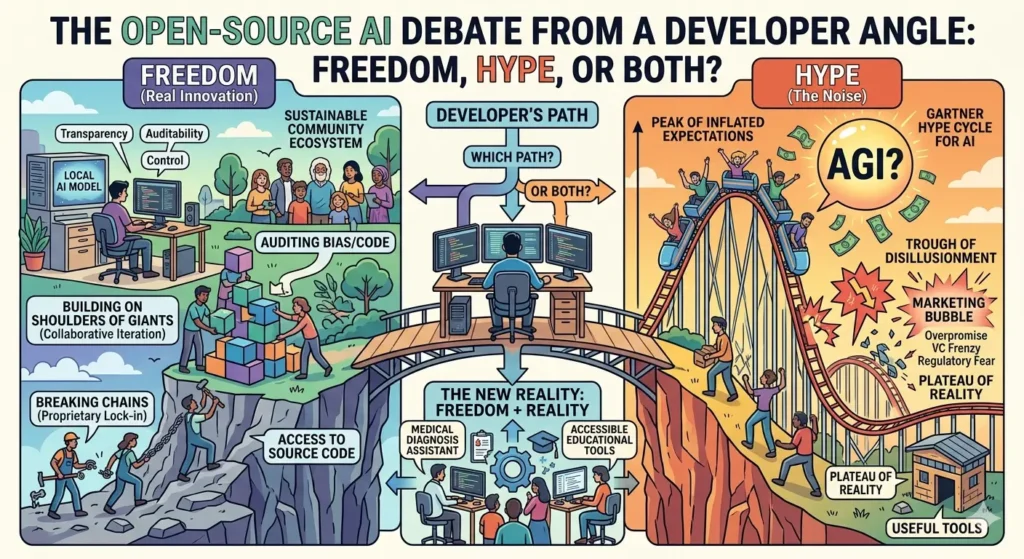
A few weeks ago, I was running Qwen 3.6 locally on a single RTX 3090, and it answered a tricky coding question better than the proprietary model I’d been paying for. That felt like a small earthquake. The open-source AI debate from a developer angle isn’t theoretical anymore — it’s something you bump into every time you choose a model, sign a license, or push code to production. The capability gap has shrunk, the licensing fights have gotten louder, and honestly? It’s hard to tell who’s “really” open anymore. So let’s break it down without the marketing fog.
What the Open-Source AI Debate from a Developer Angle Really Looks Like
If you’ve followed AI even casually, you’ve probably heard the slogans. “Open source AI will save us.” “Open source AI is dangerous.” Both sides shout, both sides have a point, and most developers are just trying to ship something that works.
The real debate isn’t about ideology. It’s about practical questions: Can I fine-tune this? Can I deploy it commercially? Do I get to see the training data? What happens if the vendor changes the license tomorrow? These aren’t philosophical concerns — they’re Tuesday-morning concerns.
And in 2026, those questions matter more than ever, because the open-weight ecosystem has exploded. DeepSeek V4, Qwen 3.6, Llama 4, Kimi K2.6, GLM-5.1 — five frontier-class open-weight models shipped in roughly six weeks earlier this year, according to recent benchmark coverage. You have more options than ever, but more options means more decisions.
The “Openwashing” Problem (Why Devs Are Getting Annoyed)
Here’s something that should bother every developer paying attention: a lot of “open” AI isn’t actually open. The Open Source Initiative even has a name for this — openwashing. It’s when a company slaps the “open source” label on a model that comes with restrictions a true open source license would never allow.
Meta’s Llama license is the most-cited example. The weights are free to download, sure. But the license restricts commercial use above certain user thresholds and limits how you can train derivative models. That’s not what “open” has meant in software for the last 25 years.
OpenAI started life as open. It isn’t anymore. Mistral, which built its reputation on openness, has steadily closed off its largest models too — though it did recently move Mistral Large 3 and Small 4 back to Apache 2.0, which was a welcome about-face.
So when a developer reads “open source AI,” they need to immediately ask: open by whose definition? The OSI’s OSAID 1.0 standard is the most rigorous benchmark right now, and the list of models that genuinely pass it is shorter than the marketing would have you believe.
The Capability Gap Finally Closed in 2026
Eighteen months ago, choosing an open model meant accepting a capability tradeoff. Not anymore.
DeepSeek V4 Pro now tops the Artificial Analysis Index among open weights and ties closed frontier models on SWE-Bench Verified, based on independent benchmarking. Qwen 3.6 hit 700 million cumulative downloads on Hugging Face. Kimi K2.6 sits at #4 overall — and it’s open weights with an MIT-style license.
Translation for developers: the “you can’t really build with open models” excuse is gone.
I’ve been running parts of my own content pipeline on Qwen locally. It’s not perfect, and the proprietary models still have edges in specific tasks, but the gap is small enough that the calculation has flipped. The question used to be: “Why would I use an open model?” The question now is: “Why wouldn’t I?”
Open vs Closed: A Side-by-Side That Actually Helps You Decide
I made this table to map the real tradeoffs, not the marketing talking points.
| Factor | Open-Source / Open-Weight AI | Proprietary / Closed AI |
|---|---|---|
| Cost at scale | Cheap to free (compute only) | $0.50 – $15+ per million tokens |
| Data privacy | Stays on your hardware | Sent to vendor’s servers |
| Customization | Fine-tune freely (license-dependent) | Limited; vendor-controlled |
| Capability ceiling | Catching up fast; near frontier | Still slightly ahead on edge cases |
| License risk | Can change (Mistral, OpenAI history) | Locked into vendor terms |
| Ease of setup | Hours to days (Ollama, vLLM, hosting) | Minutes (just an API key) |
| Audit & inspection | Weights inspectable; training data rarely | Mostly opaque |
| Vendor lock-in | Low — swap models anytime | High — switching costs are real |
| Long-term control | You own the artifact | You rent the artifact |
| Best for | Privacy-sensitive, high-volume, custom workflows | Quick prototyping, frontier capability needs |
The honest summary: open wins on control and cost, closed wins on speed-to-ship and absolute peak capability. Which one matters more depends entirely on what you’re building.
Licensing Is the Quiet Landmine
This is the part nobody talks about until it bites them. The license is the actual product. Weights are easy to download. Knowing what you’re legally allowed to do with them is harder.
Some of the most permissive options in 2026:
- Apache 2.0 — Qwen 3.6, Mistral Large 3, Gemma 4. Do almost anything, including commercial use.
- MIT — DeepSeek, GLM-5. About as permissive as it gets.
- Llama Community License — Free for most, but with commercial thresholds and derivative-training restrictions. Not OSI-compliant.
- Research-only licenses — Some labs ship “for research” weights you legally can’t deploy commercially.
I learned this the hard way when I almost shipped a side project on a model whose license said “non-commercial.” Caught it the night before launch. Read your licenses, friends. Twice.
The EU AI Act makes this even more important. The Act gives certain exemptions to genuinely open source AI — but only if it meets a specific definition. If you’re claiming open source benefits for a model that’s just open weights, you’re walking into a regulatory mess.
The Cost Math: Where Open Actually Wins
Let’s talk dollars, because this is where the open source AI debate from a developer angle gets really practical.
For a hobby project sending a few thousand tokens a day? Just use a proprietary API. The math doesn’t favor self-hosting. You’ll pay pennies and skip the operational overhead.
For a real product pushing 50 million-plus tokens a month? The math flips hard. A proprietary API at average rates could run you several thousand dollars monthly. The same workload on a self-hosted open model on a rented GPU might be $300–$800. That’s not a small savings.
But — and this is the part developers underestimate — self-hosting comes with hidden costs:
- GPU rental or purchase (an H100 isn’t cheap)
- Inference optimization (vLLM, TensorRT, quantization tuning)
- Monitoring and uptime work
- Engineering time you could have spent on features
The break-even point varies, but most analyses put it somewhere north of 50 million tokens per month. Below that, the API is usually cheaper once you count your time. Above it, open wins decisively.
The Safety Argument and Why It Cuts Both Ways
Here’s where the debate gets philosophically thorny. People who oppose fully open models argue that releasing frontier capabilities without restrictions enables misuse — bioweapons research, cyberattacks, disinformation at scale. That isn’t a strawman. It’s a real concern, taken seriously by serious people.
But the counter-argument from the open camp is just as strong. Concentrating frontier AI in three or four corporate hands creates a different kind of risk: a small group deciding what billions of people can and can’t ask an AI. That’s not a comfortable distribution of power either.
For developers, the honest answer is somewhere in the middle. Most of us aren’t building dual-use tech. We’re building chatbots, search tools, content systems, code assistants. The “what if it’s misused” panic doesn’t really apply to the median use case. But it does apply to some, and pretending otherwise is dishonest.
What’s the right tradeoff? I don’t think anyone fully knows yet. But the conversation deserves more nuance than the loudest voices on either side give it.
What I’d Tell Any Developer Choosing Today
If I were starting fresh on a project in mid-2026, here’s the rough decision flow I’d run through. It’s not gospel — adjust for your situation — but it captures how I actually think about this.
- Are you prototyping? Start with a proprietary API. Don’t over-engineer. Ship something. You can swap later.
- Does your data have to stay private? Open-weight, self-hosted. No exceptions.
- Is your volume high? Open wins on cost above ~50M tokens/month.
- Do you need the absolute best reasoning available right now? Probably still proprietary — but check this month, because it keeps changing.
- Are you in a regulated industry? Open source AI gives you audit and inspection rights you simply can’t get from closed APIs.
- Are you in the EU? Read the AI Act exemptions carefully. They matter.
For my own work, I run a hybrid. Proprietary models handle the high-end reasoning and tasks where capability matters most. Open models handle high-volume work, anything privacy-sensitive, and any task where I want to fine-tune. It’s not religious — it’s pragmatic.
If you’re new to the open ecosystem, I’d recommend starting with Ollama for local experimentation, Hugging Face for model discovery, and a cloud inference provider like Together AI or Groq when you outgrow your hardware. You can find more practical AI walkthroughs over on the techdaily360 homepage and in our ongoing AI tools and tutorials section.
Final Thoughts on the Open-Source AI Debate from a Developer Angle
The thing nobody tells you about this debate is that it’s not actually one debate. It’s five: licensing, capability, cost, safety, and sovereignty. They each move at different speeds, and the right answer depends on which one matters most for your project.
What’s clear is that 2026 is the year open-weight models stopped being a curiosity and became a real default for many use cases. If you haven’t tested one on your actual workload recently, you’re working with outdated information. The ecosystem moves fast — what was true in March doesn’t necessarily hold in June.
So here’s my unsolicited advice: download a model this week. Run it. See what it does on your real problems. Whatever side of the debate you land on, you should land there from experience, not from headlines. The open-source AI debate from a developer angle is finally one developers can actually have intelligently — because the tools are good enough that the conversation is worth having.