


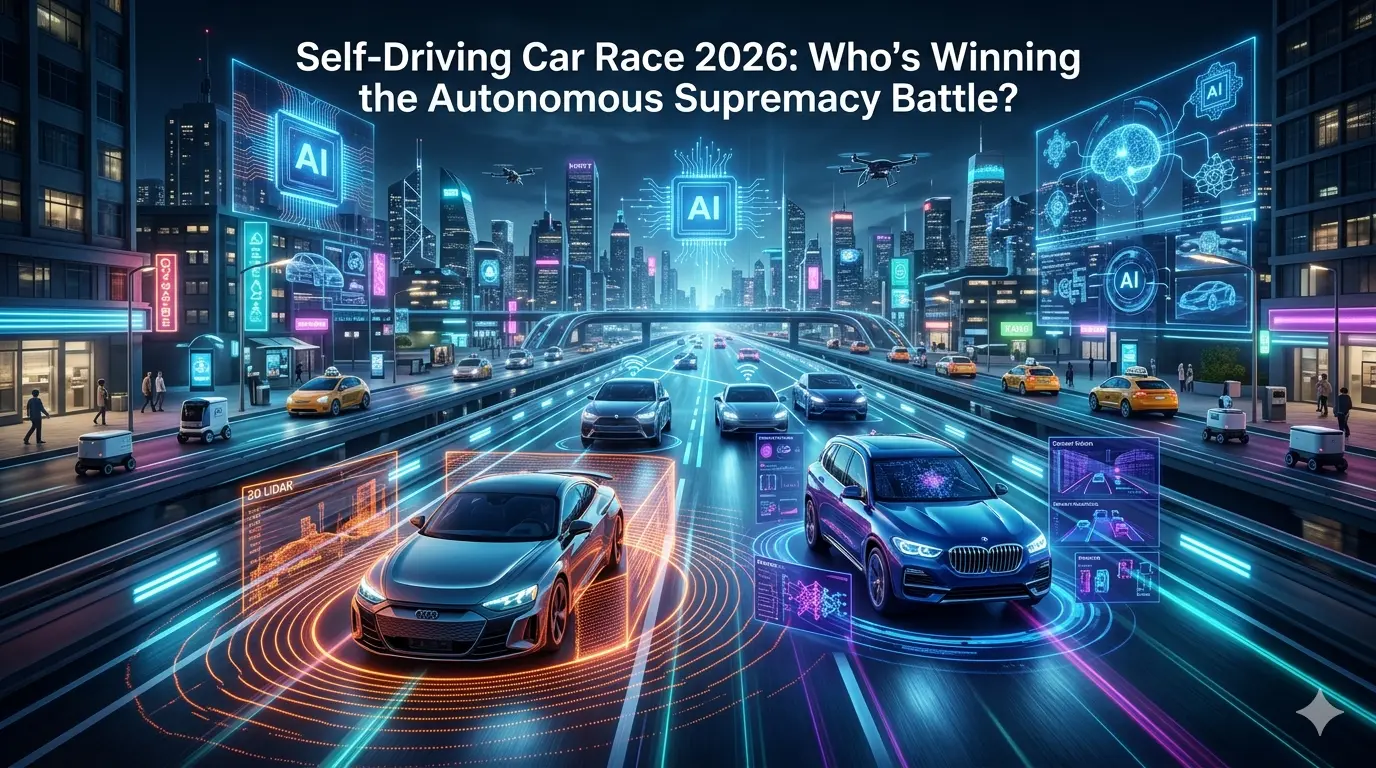
The self-driving car race isn’t what it was in 2022. Two of the names you’d have listed back then — Cruise and Apple — have officially dropped out, and a fresh tier of contenders from outside the US has quietly closed the gap. The autonomous supremacy battle is now a smaller, sharper fight between companies that actually ship driverless miles and companies that mostly ship press releases. The winners aren’t always who you’d expect.
So who’s really leading, who’s faking it, and who’s about to surprise everyone? The honest answer requires throwing out the old leaderboard and reading the new one.
The rise of self-driving cars: from concept to commercial service
The technology stopped being theoretical somewhere around 2020. Since then, autonomous driving has crossed three real thresholds — fully driverless rides paid for by real customers, autonomous freight running scheduled routes, and consumer driver-assist features used by millions every day. Each milestone happened in a different company’s hands.
The hard part was never the demo. The hard part has always been the unit economics, the regulation, and the public trust required to operate at scale. That’s what has separated the survivors from the dropouts.
Key players in the self-driving tech race (2026 edition)
The leaderboard looks different than it did 18 months ago. Several familiar names have exited; a few new ones have arrived; and one international player has quietly outpaced most of the West on actual driverless trips delivered.
The current top tier:
- Waymo (Alphabet) — fully driverless commercial service across multiple US cities
- Tesla — millions of consumer vehicles with supervised driver-assist and a limited robotaxi pilot
- Zoox (Amazon) — purpose-built driverless robotaxis live in Las Vegas and Foster City
- Mobileye (Intel) — autonomous-driving stack supplying multiple automakers globally
- Baidu Apollo Go — China’s largest fully driverless ride-hailing service by trip volume
- Wayve — UK-based, “embodied AI” approach using vision and learning, no HD maps
- Xpeng / Pony.ai — Chinese players advancing rapidly on consumer-vehicle autonomy
The dropouts matter too. The story isn’t complete without them.
Tesla: the household name with the riskiest bet
Tesla is the most-discussed name in autonomy and also the most-misunderstood. The company’s Autopilot and Full Self-Driving Supervised features are SAE Level 2 — driver assistance, not autonomy. Tesla has spent years promising true Level 4 autonomy through over-the-air updates, and the timeline has shifted repeatedly.
The advantage Tesla has is data. Millions of cars on the road feeding video back to Tesla’s training infrastructure gives the company a dataset no competitor can match. Whether vision-only AI is enough to reach full autonomy is the bet the entire company has been running for nearly a decade.
The 2024 reveal of the Cybercab — a purpose-built robotaxi with no steering wheel — was Tesla’s commitment to the Level 4 future. Limited service is promised in 2026. Tesla’s official Autopilot page is the cleanest source on current capability versus stated roadmap.
Waymo: the quiet leader that just kept shipping
Waymo, an Alphabet subsidiary, doesn’t make much noise — and it’s still the clearest commercial leader in fully driverless operation. The Waymo One service runs in Phoenix, San Francisco, Los Angeles, and Austin, with active expansion into Atlanta, Miami, and Washington DC through an Uber partnership.
Waymo’s tech stack — LiDAR, radar, cameras, HD pre-mapped routes — is the opposite philosophy to Tesla’s vision-only bet. The trade-off has produced a vehicle that drives only in specific cities, but drives there genuinely without a human. The Waymo safety hub shows roughly 81% fewer injury-causing crashes per million miles than human drivers in the same operating areas.
The next 12 months will test whether Waymo can keep the lead as cheaper, faster-moving competitors close in.
Cruise: GM’s bold bet that ended badly
Cruise was on this list a year ago. It isn’t anymore. After a serious October 2023 incident in San Francisco where a Cruise vehicle struck and then dragged a pedestrian, the company’s permits were suspended and operations wound down.
GM officially pulled Cruise out of robotaxi development in December 2024, refocusing remaining engineering on Super Cruise — the consumer driver-assist product. Cruise is now a cautionary tale, not a contender. The lesson from the collapse: a single mishandled incident can erase years of progress in public trust, even when the underlying tech is competent.
Apple Project Titan: the most expensive non-answer in tech
Apple’s secret car project ran for over a decade and burned an estimated $10 billion. In February 2024, Apple officially cancelled it and redeployed staff to AI work.
The death of Project Titan was the clearest signal yet that consumer-vehicle autonomy is brutally hard to monetise — even with Apple’s resources. The takeaway: shipping autonomous tech is mostly a regulatory, infrastructure, and operations problem, not just a software problem. Apple’s strength is software.
The new contenders: Zoox, Wayve, Baidu, and the Chinese push
Three names are reshaping the race and rarely get mainstream coverage in the US.
Zoox, owned by Amazon, has shipped a purpose-built bidirectional robotaxi — no front or back, four passengers facing each other. Commercial service launched in Las Vegas and Foster City, California in 2025.
Wayve, based in London, is building an “embodied AI” approach — no HD maps, no LiDAR, learning from raw video. The company raised over $1 billion from Microsoft, Nvidia, and SoftBank in 2024 and is now testing in multiple UK and US cities.
Baidu Apollo Go is the volume leader globally that almost no one outside China discusses. The service operates in over 10 Chinese cities, has crossed 8 million fully driverless rides, and is expanding to Hong Kong and parts of the Middle East.
For context on the wider AI infrastructure powering all of this, our coverage of how the AI compute boom is reshaping consumer tech is worth a read.
Self-driving leaders compared at a glance
| Company | Tech approach | Current status (mid-2026) | Why it matters |
|---|---|---|---|
| Waymo | LiDAR + radar + cameras + HD maps | Fully driverless in 4+ US cities | Largest verified safe-miles record in the West |
| Tesla | Vision-only AI, consumer fleet data | Level 2 supervised; Cybercab limited launch | Biggest training dataset but unproven at Level 4 |
| Zoox | Purpose-built bidirectional robotaxi | Commercial service in 2 US cities | Vehicle design rethought from scratch for autonomy |
| Mobileye | Stack sold to automakers (BMW, VW, etc.) | Deployed across millions of vehicles | Quiet B2B path to scale that bypasses ride-hailing |
| Baidu Apollo Go | LiDAR + camera fusion, robotaxi | 8M+ driverless rides in 10+ Chinese cities | Global volume leader most Western press ignores |
| Wayve | “Embodied AI”, vision-only, no maps | Multi-city pilots, no commercial service yet | Could leapfrog HD-map approaches if it works |
| Cruise | Wound down | Folded into Super Cruise (consumer ADAS) | Cautionary tale — public trust is the real moat |
| Apple Project Titan | Cancelled Feb 2024 | Discontinued | Money alone cannot solve regulatory/ops problems |
The real challenges still slowing the race
The technology has matured faster than the rest of the stack supporting it. Three things keep slowing widespread rollout — and they’re not what most people think.
Public trust. One viral video of a Waymo behaving oddly does more damage than ten thousand safe trips do good. Cruise’s collapse showed how fragile this is, and every operator is now hyper-conservative as a result.
Insurance and liability. When a human-driven car crashes, the driver is liable. When a Waymo crashes, the answer is still being written. Insurers are watching the NHTSA’s evolving guidance on automated-vehicle reporting closely.
Unit economics. Building a robotaxi costs upwards of $150,000 today. Operating one — remote-assist teams, maintenance, cleaning, charging — adds significant cost per mile. The ride-hailing math only works at sustained high utilisation.
There’s also the ethical layer — the trolley-problem questions that get more press than they deserve. In real operation, the decisions a robotaxi faces are almost always slow-down-or-not, not crash-into-A-or-B. The big ethical questions are about deployment scale and labour displacement, not life-or-death calculus.
The future of self-driving cars: what the next 24 months actually look like
Three trends to track over the next two years:
- Robotaxi geographic expansion accelerates. Expect at least three more US metros and several international cities to gain driverless service by end of 2027. Waymo, Zoox, and Baidu are all moving aggressively.
- Consumer driver-assist consolidates around two or three stacks. Mobileye, Tesla, and probably a Chinese contender will end up powering most of the world’s new cars. Smaller players will license rather than build.
- Regulation finally catches up. The US federal autonomy framework is overdue; the EU’s AI Act now covers autonomous-vehicle decision systems; China is moving fastest on national rules. Expect material updates by 2027.
For more on the broader regulatory environment, our analysis of how Big Tech is being reshaped by global AI rules lays out the framework.
The question isn’t whether self-driving cars become mainstream. It’s which company’s stack you ride in when they do.
What to watch next
- Tesla Cybercab limited launch. If it ships at Level 4 in any US market in 2026, the vision-only bet pays off and the rest of the industry has to rethink LiDAR economics.
- Zoox’s Las Vegas expansion. Whether the bidirectional vehicle wins customer preference will tell us if purpose-built design matters more than retrofitted SUVs.
- Baidu’s first international city. Apollo Go’s expansion outside China would force Western regulators to address the geopolitics of foreign-operated autonomous fleets.
- Wayve’s first commercial pilot. A vision-only, map-free approach reaching paid service would validate a much cheaper scaling path than Waymo’s.
FAQ
What are self-driving cars?
Self-driving cars are vehicles that use sensors, cameras, AI software, and (usually) LiDAR or radar to navigate without human input. They range from Level 2 driver-assistance systems requiring full human attention up to Level 5 fully autonomous vehicles needing no human at all. Most commercial systems today operate at Level 2 or Level 4 within geofenced areas.
Who is leading the self-driving car race in 2026?
Waymo is the clearest commercial leader in fully driverless ride-hailing in the West, with services in four US cities and active expansion. Baidu Apollo Go leads globally by trip volume thanks to its scale across 10+ Chinese cities. Tesla leads in fleet size and consumer reach but operates at Level 2 supervised autonomy.
Are Tesla’s cars fully autonomous?
No. Tesla’s Autopilot and Full Self-Driving Supervised features are SAE Level 2 — driver assistance requiring constant human supervision. Tesla has promised true Level 4 autonomy via the Cybercab robotaxi, with limited service expected in 2026, but no fully autonomous Tesla product is commercially available today.
What happened to Cruise and Apple’s self-driving projects?
GM wound down Cruise’s robotaxi operations in late 2024 following a serious October 2023 pedestrian incident in San Francisco; Cruise tech was absorbed into GM’s Super Cruise consumer driver-assist. Apple officially cancelled Project Titan in February 2024 after spending over a decade on it, redirecting resources to AI work.
When will self-driving cars be widely available?
Driverless ride-hailing is already commercially available in select cities. Widespread availability across most metros is likely 5–10 years away. Personal ownership of true Level 4 autonomous cars remains further out — closer to a decade — because the regulatory, insurance, and infrastructure work has barely started for consumer vehicles.
What’s Waymo’s main advantage?
Waymo has the largest verified safe-driverless-miles record in the Western market and a multi-year operational head start. Its sensor-fusion approach (LiDAR, radar, cameras, HD maps) produces conservative, reliable behaviour. The trade-off is geographic limitation — Waymo only drives where it has been pre-mapped.
Is any company beating Waymo on volume?
Yes. China’s Baidu Apollo Go has crossed 8 million fully driverless rides across more than 10 cities and significantly out-paces Waymo on trip volume globally. Western coverage rarely surfaces this, but on raw driverless-miles delivered, Apollo Go is the world’s largest operator.
How do self-driving cars improve safety?
Human error contributes to roughly 94% of US traffic crashes according to NHTSA data, and autonomous systems remove distraction, fatigue, and impairment. Published Waymo data shows 81% fewer injury-causing crashes per million miles than human drivers in equivalent areas. The safety case is real but conditional on the operating environment and stack quality.