


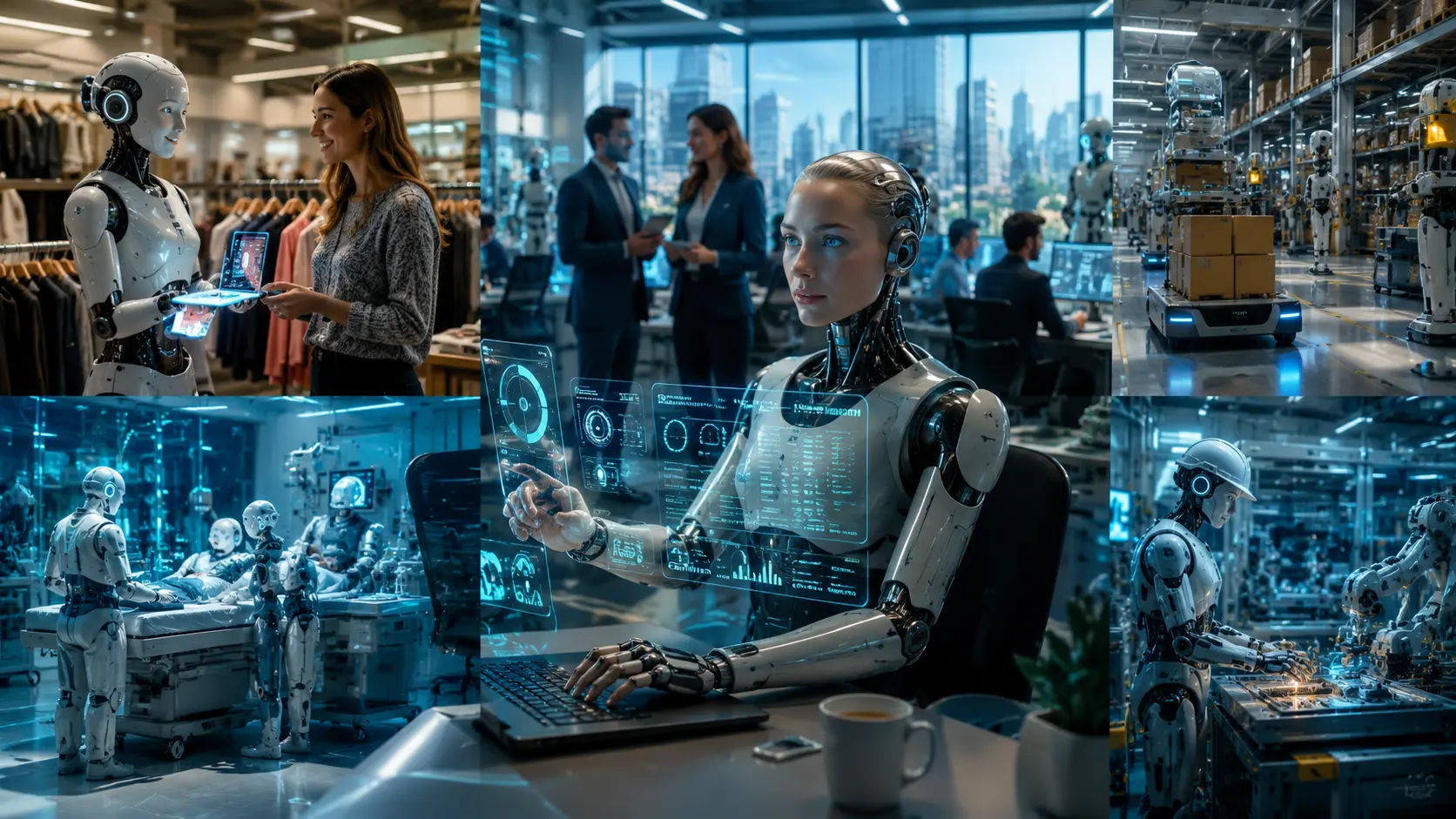
The humanoid robot industry shipped more working machines in the last 12 months than in the previous 30 years combined. That sentence sounded impossible in 2023. In 2026, the question isn’t whether humanoid robots will work — several already do — but which humans they replace first, in which jobs, and on what realistic timeline. The honest answer is much narrower than the marketing suggests, and much faster than the skeptics admit.
This is the 2026 humanoid robot landscape stripped of hype. Seven companies actually deploying machines, the jobs each one targets first, the gap between staged demos and real workplaces, and the structural question almost nobody is asking out loud: what happens to the workforce in the industries where deployment lands fastest.
What “humanoid” actually means in 2026
The category has tightened in the last two years. A “humanoid” robot in 2026 means a bipedal machine roughly five to six feet tall, with two arms and articulated hands, designed to operate in human-built environments without needing custom infrastructure. That definition rules out four-legged Spot-style robots and rigid industrial arms — the value proposition of humanoid is specifically that they fit where humans already work.
Three technical thresholds had to fall for the category to become real:
- Foundation-model breakthroughs in manipulation. Earlier robots could walk; they couldn’t grasp, pour, or sort. Recent advances in vision-language-action models and large-scale teleoperation datasets changed this.
- Battery density caught up to the demands of a full-mobility humanoid form factor. Most current humanoids can run 4–8 hours on a charge.
- Cost per unit dropped from roughly $500K-$1M in 2022 prototypes to $30K-$150K in 2026 production targets.
None of those are speculative anymore. All three have shipped in real machines this year.
The 7 companies that actually matter in 2026
The leaderboard has consolidated. A dozen well-funded startups exist; seven of them are credibly deploying machines at scale or close to it.
1. Tesla Optimus
Tesla’s Optimus Gen 3 is on track for limited internal deployment in Tesla factories during 2026, with broader external sales targeted for 2027. Elon Musk has projected 5,000-10,000 units produced in 2026 — characteristically optimistic, but the production line is real. Target price: $20K-$30K at scale.
2. Figure AI
Figure 02 is the most-deployed third-party humanoid in 2026, with units running in BMW’s Spartanburg plant and an expanding pilot at a major US logistics customer. The company’s partnership with OpenAI for the underlying language and reasoning model is the strategic edge. Recent valuation: $39B as of the early 2026 round.
3. Boston Dynamics Atlas (electric)
Boston Dynamics retired the hydraulic Atlas in April 2024 and revealed the all-electric successor, now running commercial pilots with Hyundai (the company’s owner) and a small set of automotive customers. The electric Atlas is more graceful than its predecessor — and notably quieter, which matters in workplace deployment.
4. Apptronik Apollo
Apollo is currently piloting in Mercedes-Benz manufacturing facilities under a partnership announced in 2024. Apptronik has positioned the robot specifically for “general-purpose physical labour” — moving totes, simple assembly, inspection. The company hasn’t pursued the consumer market, which has accelerated industrial adoption.
5. 1X Technologies NEO
NEO Beta and its 2026 successor NEO Gamma are the most consumer-focused humanoids in the category, positioned for home use. The market reality: 1X is selectively shipping to early-access customers at roughly $20K per unit, with a much wider release tied to enterprise revenue from EVE — the company’s wheeled commercial robot.
6. Agility Robotics Digit
Digit isn’t strictly humanoid in the bipedal-with-arms sense, but it’s the closest thing actually working at scale. Currently deployed across multiple warehouses including a public Amazon pilot, doing tote handling and bin moving. The most boring use case on this list. Also the most commercially mature.
7. Chinese contenders (Unitree, Xpeng, Fourier, BYD)
The Chinese humanoid push has accelerated faster than Western press covers. Unitree H1 ships at roughly $16K — cheapest credible humanoid on the market. Xpeng PX5, Fourier Intelligence GR-1, and BYD’s internal humanoid programme are all shipping units to factories inside China. By unit volume in 2026, China likely deploys more humanoids than the US.
The 7 humanoid robot leaders compared
| Maker | Deployment status (mid-2026) | Target use case | Approx unit price | Strategic edge |
|---|---|---|---|---|
| Tesla Optimus | Tesla factories first; ramping production | General factory work; consumer “in time” | $20K-$30K target | In-house manufacturing scale |
| Figure 02 | BMW + logistics pilots, expanding | Industrial general-purpose | ~$60K-$100K | OpenAI model partnership |
| Boston Dynamics Atlas | Hyundai + automotive pilots | Heavy industrial tasks | Not commercially priced | Decades of locomotion R&D |
| Apptronik Apollo | Mercedes-Benz factories | General-purpose physical labour | ~$50K (target) | Industrial-first focus |
| 1X NEO | Early-access consumer ships | Home + commercial | ~$20K | Consumer-segment focus |
| Agility Digit | Multiple US warehouses live | Logistics tote handling | ~$30K-$45K | Most operationally mature |
| Unitree H1 (China) | Volume shipping in China | Research + factory pilots | ~$16K | Cheapest credible humanoid |
Which jobs actually get replaced first
The honest 2026-2028 outlook is narrow. Humanoid robots are not going to replace nurses, teachers, or knowledge workers. The realistic first wave looks like this:
- Tote and bin handling in warehouses. Digit and Apollo are already doing this. The economics work at $30-50K per unit because the wage being replaced is a 24/7 logistics operator earning $50K+ annually.
- Repetitive automotive assembly tasks. Optimus, Figure, and Atlas are all targeting this. Bolt sorting, fastener placement, station-to-station transport — tasks too varied for traditional robotic arms but too repetitive for humans to do well.
- Quality inspection in manufacturing. Walking a production line with cameras and checking for defects is a task humanoids do credibly today. Mercedes’ Apollo pilot includes this.
- Hazardous or repetitive material handling. Especially in industries (chemicals, semiconductors, mining-adjacent operations) where the existing job is already unpleasant and high-turnover.
What’s not happening anytime soon: complex dexterous work (electrical wiring, plumbing, food prep at scale), customer-facing roles, or anything requiring genuine judgment in unstructured environments. Demo videos suggesting otherwise are mostly teleoperated. The honest “operating autonomously, all day, in production” use cases in 2026 are narrow and industrial.
The gap between demos and deployment
Almost every humanoid robot company has a viral demo that looks more advanced than what’s actually deployed. The pattern is consistent enough to warrant calling out:
- Most demos are teleoperated, with a human operator providing real-time guidance through cameras and haptic feedback.
- The “autonomous” segments are often heavily scripted, running in environments mapped to the inch in advance.
- Pre-production prototypes are showcased, sometimes years from real shipment at the price points implied.
This isn’t dishonest exactly — it’s how the industry works. But it means the gap between a Tesla demo of Optimus folding laundry and an Optimus actually folding your laundry is multi-year, not multi-month. The companies that ship real machines to real workplaces (Apptronik, Agility, Figure to a lesser extent) are quieter than the ones that don’t.
For context on how this plays into the broader AI investment cycle, see our coverage of the AI compute and capex boom.
What this means for jobs and labour markets
The honest read: the jobs at near-term risk are narrow and specific. Warehouse logistics, repetitive assembly, hazardous handling. Together those represent millions of jobs globally, so “narrow” doesn’t mean “small.” But this is not the broad automation wave the more alarmist coverage suggests.
The economics matter. At $30K-$60K per unit with 5-7 year operating lifespans, the per-hour cost of a humanoid in 24/7 operation lands around $2-4/hour, fully loaded. That is cheaper than any human wage in the US, EU, or developed Asia. It is not cheaper than wages in much of the developing world today. The first deployment wave lands in high-wage industrial economies. Lower-wage economies see the wave later, if at all.
The shape of the labour-market response will define the next decade. Reskilling programmes, robot-operator job categories, and policy responses (UBI-style schemes, robot taxes, industry-specific transition funding) are all being discussed in 2026 — mostly without coordination. Our analysis of how AI is restructuring labour markets walks through the policy framework.
What to watch over the next 12 months
- Tesla Optimus production numbers. Musk’s projection of 5,000-10,000 units in 2026 is the bellwether. If actual production lands at 1,000 or fewer, the timeline for broader humanoid deployment slips meaningfully.
- Figure’s next major customer. A second large enterprise pilot beyond BMW would validate the deployment model and likely trigger another up-round valuation.
- Chinese humanoid export. If Unitree, Xpeng, or BYD humanoids start landing in Western factories at $16K-$25K price points, the cost calculus changes overnight for every competitor.
- The first multi-100-unit deployment. No single customer has 100+ humanoids in production deployment in 2026. The first to cross that line proves the operational model works at scale.
- Labour-side response. Union contracts in manufacturing and logistics renegotiating in 2026 will increasingly include robot-deployment clauses. Watch the UAW, Teamsters, and IG Metall position papers.
The humanoid era didn’t arrive in a single moment. It started landing in factories during 2025, scaled into pilots in 2026, and will hit unmistakable mainstream presence sometime between 2027 and 2029. The companies that ship working machines to real workplaces, quietly, are the ones writing the next chapter. The viral-demo companies mostly aren’t.
FAQ
Are humanoid robots actually working in real workplaces in 2026?
Yes, in narrow contexts. Apptronik’s Apollo is operational in Mercedes-Benz factories. Figure 02 runs in BMW’s Spartanburg plant. Agility Digit is deployed in multiple US warehouses including Amazon pilots. The deployments are real but limited — typically 1 to 10 units per site, performing specific repetitive tasks rather than general-purpose work.
What jobs are humanoid robots most likely to replace first?
Warehouse tote handling, repetitive automotive assembly, quality inspection on production lines, and hazardous material handling. These tasks share three traits: high repetition, unsuitable for traditional fixed robotic arms, and existing labour costs above $40K-$60K annually. Together they represent millions of jobs globally even though the category sounds narrow.
How much does a humanoid robot cost in 2026?
Production-targeted prices range from $16K (Unitree H1) to roughly $60K-$100K (Figure 02, Apptronik Apollo). Tesla Optimus targets $20K-$30K at scale. Boston Dynamics Atlas is not commercially priced. The five-year operating cost typically lands at $2-4 per hour in 24/7 operation, fully loaded.
Which company is leading the humanoid robot race?
By unit volume actually deployed in workplaces, Agility Robotics Digit and Apptronik Apollo lead in the West, with Unitree leading globally on price-volume in China. By press attention and valuation, Tesla Optimus and Figure 02 dominate. The “leader” depends on whether you measure by deployment, by capability, by valuation, or by unit volume.
Are most humanoid robot demos honest representations of capability?
Not entirely. Most viral demos are at least partially teleoperated, scripted in heavily mapped environments, or show pre-production prototypes years away from the implied shipment. The gap between demo and deployment is typically multi-year. The companies actually shipping working machines tend to publicise their work less than the companies that aren’t.
Will humanoid robots replace knowledge workers or service workers?
Not anytime soon. The current capability ceiling is repetitive physical tasks in structured environments. Complex dexterity (wiring, plumbing, food preparation), customer-facing roles, and unstructured judgment work remain out of reach for the foreseeable future. The realistic 2026-2030 wave is industrial and logistical, not service or knowledge.
How fast is China’s humanoid robot industry growing?
Faster than Western press covers. Unitree H1 ships at roughly $16K, Xpeng PX5 and BYD’s internal humanoid programmes are all delivering units to Chinese factories. By unit volume in 2026, China likely deploys more humanoids than the US. Western export of Chinese humanoids could land in 2027 and reshape the cost calculus globally.
What’s the realistic timeline for humanoid robots in everyday life?
Industrial deployment: actively happening in 2026, scaling through 2028. Broader commercial use (retail, hospitality): mid-to-late 2020s. Consumer home use: 2028-2032 at the earliest for early adopters; mainstream household presence is closer to 2035. The Tesla and 1X “home robot” demos are real prototypes but not real products at scale.
Want sharper coverage of AI, robotics, and the technologies reshaping work? Subscribe to the TechDaily360 weekly briefing for the next dispatch.