


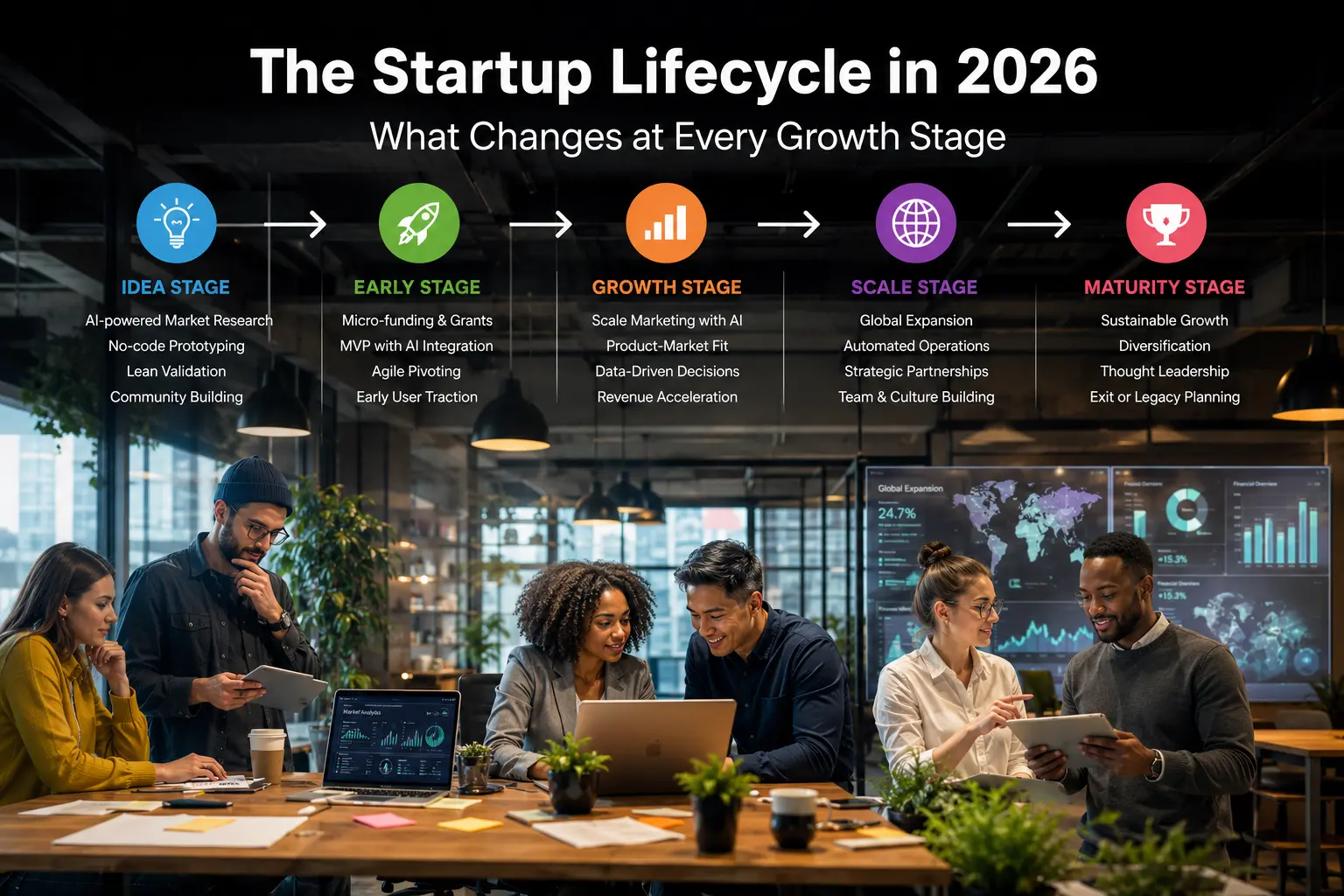
The startup lifecycle hasn’t changed shape since the 2010s — same arc from idea through scale through exit. What’s changed in 2026 is what each stage demands of the founder. The benchmarks for raising, the cost of building, the speed of distribution, and the bar for hiring have all moved, sometimes by 2× or 3×, in the last 24 months. Run a 2021 playbook against 2026 conditions and the company quietly dies in the gaps.
This is the practical diff — stage by stage, what’s structurally different now versus the playbook most founders learned three years ago. The stages are familiar. The rules underneath them aren’t.
What’s actually different in 2026
Three macro shifts colour everything that follows.
AI tooling has compressed timelines. An MVP that took six months in 2021 takes six weeks in 2026. A go-to-market motion that needed a six-person team can run on two. That sounds like good news; it’s mostly pressure. Faster cycles mean faster failures and faster competitor responses.
Venture funding has compressed and concentrated. Seed rounds are roughly the same size, but the bar to earn one is higher. Series A has roughly doubled in metric requirements without doubling in cheque size. Capital is available, but only for the top decile of any given cohort — see our analysis of the 2025–26 funding compression for the structural picture.
The talent market has split. AI-adjacent senior IC roles command 2–3× the comp of equivalent traditional software roles. Founders building anything AI-flavoured are bidding against frontier labs for the same people. Founders building non-AI startups have an easier hiring market than they’ve had in years.
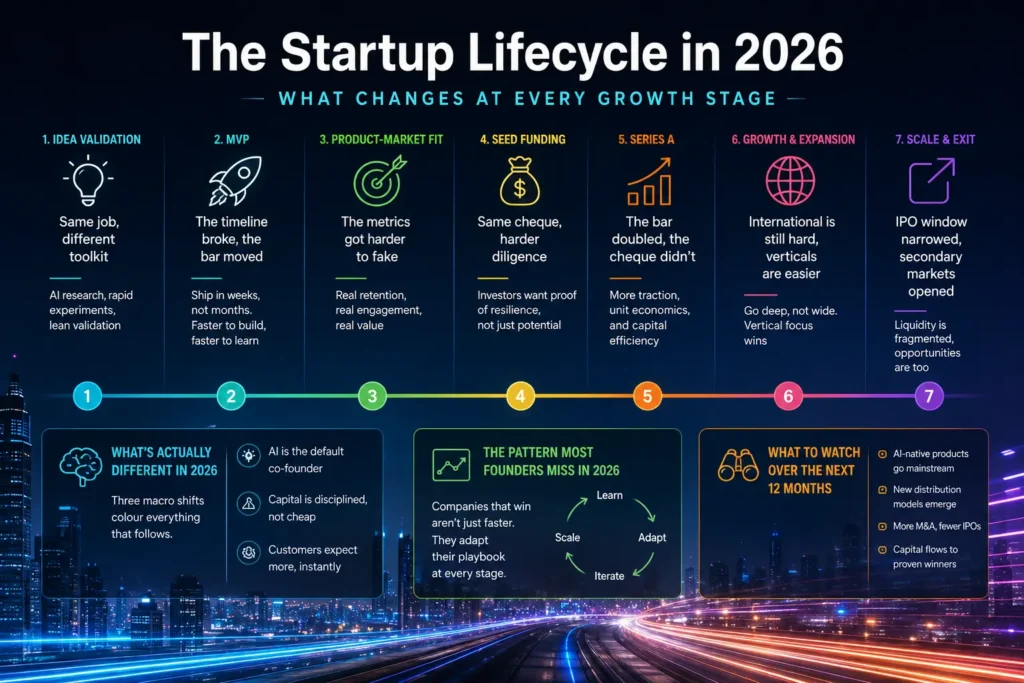
Idea validation: same job, different toolkit
The job of idea validation hasn’t changed. Test the problem before writing production code. What’s changed is the toolkit.
A 2021 founder validated through 30 customer conversations and a Typeform landing page. A 2026 founder can additionally ship a no-code prototype, an AI-generated demo video, and a fake “agent” delivered manually by hand — all in the same week. The validation surface area is wider and the cost per test is lower.
The trap: founders mistaking validation tooling for validation. Shipping a polished AI-generated demo without ever talking to a real buyer is the most common stage-1 failure in 2026. The number of conversations still matters more than the number of artefacts.
What’s actually different: the time from “interesting hunch” to “validated or killed” has compressed from 3 months to 3 weeks.
MVP: the timeline broke, the bar moved
This is where AI tooling has changed the most. Cursor, GitHub Copilot, and equivalent tools have made a working consumer MVP achievable in roughly six weeks where it once took six months. That’s a real productivity gain.
The unspoken consequence: customer expectations have moved with it. A 2021 MVP could be ugly, slow, and missing features — early users tolerated rough edges in exchange for capability they couldn’t get elsewhere. In 2026, AI-fluent users expect polished onboarding, sensible defaults, and at least decent design, even at the MVP stage. The benchmark for “minimum viable” has quietly risen.
What’s actually different: founders who ship faster but skip the design and onboarding work get worse retention than 2021 founders did. Speed without polish doesn’t compound.
Product-market fit: the metrics got harder to fake
The Sean Ellis 40% test still works. Day-7 and day-30 retention still matter. The change in 2026 is that vanity metrics are easier than ever to generate — paid TikTok bursts, AI-driven SEO, and viral demo loops can produce signup spikes that look exactly like PMF and aren’t.
Investors have adjusted. A 2021 seed pitch with strong signup growth could close on the strength of the chart. A 2026 seed pitch with the same chart gets the question “what’s the organic compounding cohort?” — and if you can’t answer cleanly, the round stalls.
What’s actually different: the bar for “real PMF” has moved from “growing fast” to “growing fast organically with retention.” Founders relying on paid acquisition to dress up early traction are caught quicker.
What changed at each stage — at a glance
| Stage | 2021 playbook | 2026 reality | Why it matters |
|---|---|---|---|
| Idea validation | 30 conversations + Typeform | + no-code prototypes + AI demos | Cycle compressed 3 months → 3 weeks |
| MVP | 6-month build, rough edges OK | 6 weeks build, polished bar required | Speed without design = worse retention |
| Product-market fit | Strong growth chart | Organic compounding cohort required | Paid acquisition no longer fools investors |
| Seed funding | $2-4M, friendly terms | $2.5-5M, deeper diligence on unit economics | Capital available only for top-decile teams |
| Series A | $5-10M on growth + story | $8-15M, needs $1M+ ARR + 3× YoY + clean economics | Bar roughly doubled; cheque size didn’t |
| Growth & expansion | Geo expansion popular | AI-native verticals preferred | International still hard; verticals reward focus |
| Scale & exit | IPO window open most years | IPO selective; secondary market dominant | Late-stage exits restructured around tender offers |
Seed funding: same cheque, harder diligence
Median 2026 tech-startup seed rounds run $2.5M–$5M at $15M–$25M post-money — broadly similar to 2021 in dollar terms. The diligence underneath is much deeper.
A 2021 seed could close on a strong narrative and an early product. A 2026 seed typically requires: clear unit economics modelling, at least one validated growth channel, references from at least three early customers, and an honest answer to “what does an AI competitor build against you in three months?” That last question is the new one, and it kills more rounds than the others combined.
What’s actually different: the time-to-close has roughly doubled. A 2021 seed could close in 4–6 weeks; a 2026 seed takes 8–12.
Series A: the bar doubled, the cheque didn’t
This is the most-changed transition in the lifecycle. Series A used to be where the company “made it.” In 2026, it’s where the company is asked to prove it’s a real business.
Typical 2026 Series A: $8M–$15M at $40M–$80M post-money, with investors expecting $1M+ ARR, 3× year-over-year growth, CAC payback under 18 months, and NRR above 100%. Compared to 2021 — when a credible story and 3-5× growth was often enough — the metric bar has roughly doubled. The cheque size has not.
What’s actually different: companies raising Series A in 2026 are more mature than 2021 equivalents but raising the same money. The runway implication is real — many founders are surprised that their A round buys 18 months instead of the 24 they planned for.
Growth and expansion: international is still hard, verticals are easier
The conventional wisdom in 2021 was that international expansion was the next move after Series B. Most companies that tried it retreated within two years; the playbook didn’t survive contact with local complexity.
In 2026, the better second-curve move for most companies is vertical depth. AI-native verticals — legal, biotech, defence, healthcare ops — reward focus more than they reward geography. The first companies hitting $100M ARR inside a single vertical are doing it without international expansion at all.
What’s actually different: founders defaulting to “London is the obvious next market” are mostly making last-cycle decisions. The interesting growth surface in 2026 is depth, not breadth.
Scale and exit: the IPO window narrowed, secondary markets opened
The third major shift: late-stage exits have restructured around continuous secondary offerings rather than discrete IPOs. Platforms like Hiive, Forge, and EquityZen have made it possible for founders and early employees to liquidate meaningful stakes without taking the company public.
For founders, this changes the timeline calculus. A 2021 founder building toward IPO ran on a five-to-seven-year clock with secondary liquidity as a bonus. A 2026 founder can structure 20-30% personal liquidity in tender offers across years 5-10 while staying private, then choose between IPO, strategic acquisition, or perpetual independence on their own schedule.
What’s actually different: the pressure to go public has dropped meaningfully. Companies are staying private longer and exiting through structures that didn’t exist five years ago.
The pattern most founders miss in 2026
The single biggest mistake in 2026 is running a 2021 playbook on 2026 cost and competition curves. Specifically:
- Hiring as if engineering is still the bottleneck (it isn’t — design and distribution are)
- Spending on paid growth as if CAC was still 2021-level (it’s typically 2× higher)
- Raising on storytelling as if metric bars hadn’t moved (they have, materially)
- Defaulting to international as the growth second-curve (vertical is usually better)
- Building toward IPO as the exit (most founders should structure secondaries instead)
The founders who win in 2026 aren’t the ones who learned a new playbook. They’re the ones who keep updating the old one as conditions change underneath them.
What to watch over the next 12 months
- AI inference cost trajectory. Another 50% drop in H2 2026 changes seed and Series A unit-economics math meaningfully.
- Series A close rates. If the median time-to-close stretches further, founders need to plan 30-month runways at seed, not 24.
- Vertical AI exits. The first $1B+ acquisition of a vertical AI startup validates the depth-over-breadth thesis decisively.
- Secondary market volume. If tender-offer volume continues compounding, the IPO becomes optional rather than default for the next generation of founders.
The startup lifecycle isn’t broken in 2026. The rules just keep moving, and the founders who notice are quietly building meaningfully better companies than the ones who don’t.
FAQ
What’s the single biggest change to the startup lifecycle in 2026?
Timeline compression. AI tooling has shortened the build cycle at every stage — MVP, iteration, growth experimentation. The catch is that competitive responses have shortened at the same rate. The startups that move fastest still win, but the window to be first is much narrower than it was in 2021.
Is the 2026 Series A really twice as hard to raise as 2021?
By metric bar, yes. The cheque size is similar, but investors typically now require $1M+ ARR, 3× year-over-year growth, CAC payback under 18 months, and net revenue retention above 100%. In 2021, a credible story plus 3-5× growth was often enough. The bar has roughly doubled without the round size matching.
How much should founders raise at seed in 2026?
Enough for 24–30 months of runway, ideally toward 30. Median 2026 tech-startup seed rounds land at $2.5M–$5M, but the Series A bar has moved, which means the seed needs to fund more progress than it did before. Plan for the metric bar at the next round, not the round you’re raising.
Has AI tooling killed the need for engineers in early startups?
No, but it’s changed what they do. Early-stage engineers in 2026 are higher-leverage but smaller in number. A two-engineer team in 2026 can build what a six-engineer team built in 2021. The bottleneck has shifted to design, distribution, and customer-facing work — areas AI tooling hasn’t transformed yet.
Are international expansions still worth attempting?
For most early-stage companies, no. The complexity-to-revenue ratio hasn’t improved much, and vertical depth tends to be a better growth lever. Companies hitting $100M+ ARR inside a single vertical are now common. International expansion remains valuable for specific business types but is no longer the default Series B move.
What does the new secondary-market structure mean for founders?
It changes the timeline calculus. Founders can now structure 20-30% personal liquidity through tender offers at years 5-10 while staying private, removing the urgency to go public. The IPO becomes an optional milestone rather than the inevitable exit, which gives founders more strategic flexibility.
How fast are seed rounds actually closing in 2026?
Median time-to-close has roughly doubled from 4-6 weeks (2021) to 8-12 weeks (2026). The diligence depth has increased significantly — investors are doing deeper unit-economics modelling and customer-reference checking before signing. Founders planning on a six-week close are routinely surprised by the longer cycle.
What’s the biggest mistake founders make in 2026?
Running a 2021 playbook on 2026 conditions. The most common version: hiring as if engineering is the bottleneck, spending on paid growth as if CAC was 2021-level, raising on storytelling as if metric bars hadn’t moved, and defaulting to international expansion as the growth second-curve. Each of these worked three years ago. Each of them quietly underperforms now.
Want sharper coverage of startup operations, funding cycles, and the structural shifts shaping how founders build? Subscribe to the TechDaily360 weekly briefing for the next dispatch.